May 13, 2013

Everything That Glitters: T.R. Hummer's "Where You Go When She Sleeps"

-->

We’ve all heard notions of falling love as the loss of oneself in merging with another, two souls and psyches becoming one. Over the years I’ve listened to discussions of whether this is love or infatuation or escapism or romanticitis extremis or psychotic delusion or horny ramification syndrome or one more tale we tell ourselves in yet another fit of self-aggrandizement.  

T.R. Hummer’s poem, “Where You Go When She Sleeps,” presents a version of that discussion: being or falling in love is like being a child who falls into a silo full of golden oats, which bury the child. This isn’t agrarian ecstasy; it’s death. And it’s not just death, but the death of a child, one who has teetered on an edge, fallen, and been smothered by the oats he found so alluring.


Some friends and I were discussing the poem, and they—all females—were outraged that Hummer would, even if only in metaphor, exploit the death of a child for the sake of an image conveying the completeness of the speaker’s love as he ponders his lady’s hair while she sleeps. I wondered aloud if--Gary Cooper and Harley-gang appearances to the contrary--males might be more inclined toward such rhapsodic extremism than women. We idolize; women plan. It's the world's dirty little secret. 

Evolutionary biologists tell us that it’s the female who does the choosing in the animal kingdom, of which we humans are a part. If that’s true, it seems to make sense that women respond more practically to potential partners as providers, fathers, reliable companions, escorts, future caretakers, and other unglamorous behaviors.

Does that mean women are less likely to fall into a silo-full of oats in the name of love? If so, is that a good thing?

In a related vein, over the years some female friends have agreed that most women need to experience loving a bastard, but only briefly and only once. Eventually women tend to choose mates more wisely. They want stability and security; it’s in their hard wiring, from chickadees to corporate lawyers.  

Is that true? Is coital pragmatism what it means to grow up? If so, do men ever grow up, or do we just keep tumbling into the vast oat bins at the base of every pedestal?

Near Stratford, Ontario


May 4, 2013

David Baker, "Old Man Throwing a Ball": a Homey Dialectic


As the title alone might suggest, David Baker’s “Old Man Throwing a Ball” offers warm, welcoming images, feelings, and ideas about humans, dogs, and spring. We see many reasons to like being alive in spite of the poem's honest awareness of how temporal those images are. There's an impressive, homey dialectic here, about life and death, order and wildness, and I’m glad for the poem’s company even though I have more questions about word choice than I usually do in a poem I admire. 

 
So, first, my reservations. Suspecting a typo for “lopes,” I had to look up the verb “lop,” which can mean to droop or to move awkwardly. I suspect it also plays on the more familiar “lope,” either of which could describe the dog’s motion in a way that makes him attractive, lovable, and sympathetic.

At the end of the second stanza, I struggle with the introduction of the old woman:  “Now his mother // dodders out, she’s old as the sky, wheeling / her green tank with its sweet vein, breath.”

I think she’s the old man’s wife, but then why “mother”?  If the man is already aged enough to stand “atilt” and earn the title of “old guy,” it seems unlikely that his mother—literally, his mother, not a wife as surrogate mother—is the second human character. I realize that some couples who’ve been married a long time refer to each other as “mother” and “father,” but here it’s the speaker who’s using that term of endearment, though he seems a stranger to both of the older people.  

I wrestled for a long time with the old woman’s “wheel”ing of a “green tank.” It must be an oxygen tank with its “sweet vein” of “breath,” but I wonder if that image and action could have been clearer. Are all oxygen tanks green? How many readers know that? Do all old women with oxygen tanks make a man turn to his dog for love? If so, does that fact make us squirm some?


Despite some metrical irregularities--which are more desirable than a cadence with military or nursery-school regularity--the poem walks by in a casual blank verse (unrhymed iambic pentameter), so I wonder if Baker has forced some word choice to fit the meter. But David Baker is an eminent and contemporary poet; it seems unlikely he’d fall into that trap, so I’m trying to  assume that any miscommunication is my fault.

I’m a little uneasy with the cute poet-trick-word-play at the end of the fourth stanza and beginning of the fifth. The down-spread watering cans are followed immediately by “up,” which is the direction of the dog’s huffing. However, I love the brazenly lovable sweetness of the lab’s “mouthy ball.” Anyone who doesn’t is simply wrong—and perhaps not entirely human. So maybe it’s okay to lead into it with that play on Down and Up, with Up winning for now, though it huffs to do so.

Also, this curious juxtaposition of opposing directions is abrupt and self-conscious. It’s arguable that the sounds and meanings, especially across adjoining stanzas, further the quality of likability that informs the rest of the poem. Up and Down, we’re all in this together as we bounce along, more or less merrily.

My final question:  what does it mean to have antique watering cans that are “down-spread”?  Are the spouts tilted to the ground so that flowers reveal themselves in the holes at the tops of the cans?

I’m taking time to puzzle over all this because I very much like the poem as a whole. I like what it implies as well as its way of speaking. In spite of their age and creakiness, the characters and actions convey the season of spring, full of life and hope. Amid images of fading, I feel permitted to hope life will go on as long as the black dog keeps returning with his “mouthy ball.” The mythology, energy, and illusions of springtime promise that he’ll do it forever.

When Baker dares to declare, “These are the true lovers, / this dog, this man,” he’s knocking on sentimentality’s door. However, the statement is so hyperbolic, so seemingly outrageous that we can feel a touch of humor and irony in it, especially as they set the stage, more gravely, for the old woman with her green oxygen tank. The adage about dogs as man's best friend earns new meanings, new life. 

On the other hand, whether humorously or seriously, we might worry about the man’s preferring the dog to the wife/mother. Isn’t man’s connection to a wife and/or mother supposed to be the love story? But in this woman, there’s sickness and lurking mortality, while the dog offers not only the requisite unconditional dog’s love, but also an enduring image of vitality and action, even in old age. Maybe the man tosses the ball “even farther” after the dog "pees" because urination is a biological function, and biological functions echo our mammalian mortality. The dog’s peeing is a necessary pause in the thoughtless, epic ball-throwing marathon, which irritates and, perhaps unconsciously, worries the man. 

So throughout the poem there’s a tension, or dialectic, between chaos, vulnerability and mortality on the one hand and, on the other hand, order, affection and life. The old man is “atilt,” the black lab “lops,” the old woman “dodders” and “tips” down the path, and even the flowers “spill” from upside-down watering cans. Yet the old man is able to limber up and throw the ball still farther. The dog is indefatigable, and even the weakened old woman’s “green tank” has a “sweet vein,”—a reservoir of a bit more “breath” and a few more days or months.


The grass’s “rippling” strikes me as appealing and pretty, but it must go in the same worrisome column as the “wild elsewhere in our world.” Still, the man’s made a “path” for her there, and that path is “trim, soft underfoot.” The untamed and the comfortable are in a constant back-and-forth. The flowers spill, and the old man cannot name the third species of flora; so he relegates it to that same “wild elsewhere,” which he will one day “tend.”  (And what a magnificent, provocative phrase we’re given in a “wild elsewhere.” Are all our elsewheres "wild" by definition?). 

In Baker’s wonderful last line, that unnamed flower—wild and therefore chaotic—will nevertheless come when he calls for it. It will be tamed, like the dog or the “split rails” that are “docked” (like carefully arranged boats in a marina)  “along the front walk.”  In the yard “every inch” is “pruned” into “fine blossom” and made “miniature.” The stones are “set.”  Nothing is left to chance.

I hear echoes of Yeats’ fondness for manicured nature, as in “The Wild Swans at Coole,” rather than Wordsworth’s passion for mountains which are themselves passionate, full of winds and storms that both menace and instruct him. In Baker’s poem humans are engaged in a lovable effort to manage nature and wildness. That could easily be mocked as a sterile, mechanical, foolishly neoclassical, micromanaged scene; but Baker sees the humanness of it all and smiles. Man, “mother,” and dog will lose their struggle against chaos, wildness and death, but for the moment the speaker embraces them. Even in the lab's repetition of returning with the ball, we see a desire for harmony, order, affection. Throughout Baker's homey dialectic, the speaker himself becomes one more “true lover,” a benevolent sharer of a scene he’s tended for us.

Old Man Throwing a Ball by David Baker : The Poetry Foundation

Apr 25, 2013

Rainer Maria Rilke, "Archaic Torso of Apollo," trans. Stephen Mitchell

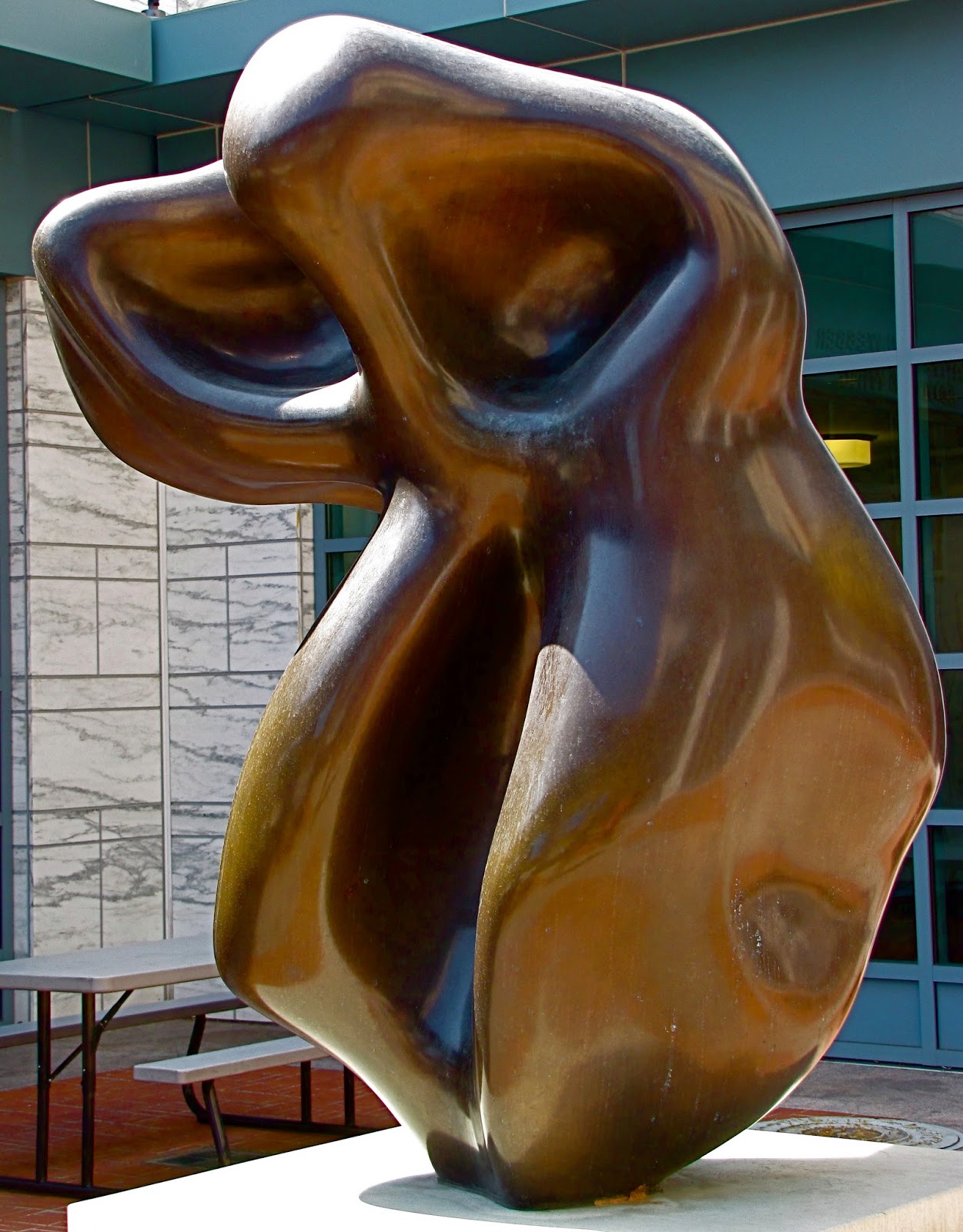
Arp, Torso of a Giant, 1964, D.I.A.
I hadn’t read Rilke’s “Archaic Torso of Apollo” in a long while, and frankly I’d forgotten about it. That's shameful, but instead of leading vapid, jejune cheers about the poem and its perplexing conclusion, let me simply admire a few of its particulars.


First, let’s note that it’s an Italian (or Petrarchan) sonnet, fourteen lines that begin with a rhymed octave (8 lines) to which a 6-line, rhymed sestet responds in some way. So it’s a bit similar to an English (or Shakespearean) sonnet’s concluding with a rhymed couplet that responds to its preceding twelve lines.

How translators manage to preserve any kind of rhyme has always impressed me. I’ve read somewhere that a good translator often has to make the choice of what’s primary—the poem’s content, including literal translation, or its formal characteristics such as rhyme and meter. At any rate, that kind of intelligence is magic to me, so hats off to Stephen Mitchell.


Apollo was the god of truth and light as well as music, poetry, and some other good things, and as foil to that loosey-goosey, hell-raising frat boy, Dionysus. I think of Apollo as the god of reason and moderation.  So the figure of a decapitated Apollo might suggest an entirely physical, animal power (“like a wild beast’s fur”) with too little wisdom or soul to “burst like a star” “from all the borders of itself.” The thinking god has lost his head.

The danger of a god’s sexual power might feel menacing us, especially as we remember Zeus' rape of Leda, the mortal, who gave birth to the child who would become Helen of Troy, and be partially responsible for a ten-year war, as her Greeks tried to retrieve here. But in Rilke's Apollo, we perceive “a smile” running “through the placid hips and thighs /  to that dark center where procreation flared.” Even there, at the “dark” sexual center, which might be anarchic power in an animal or human, the god’s internal “brilliance . . . like a lamp” illuminates and “dazzles”; he's  empowered with the light to see everything we do, even without his head.

Here, I'm reminded of Yeats’ “Leda and the Swan,” another knockout sonnet, which concludes by wondering if mortal Leda takes on the rapacious Zeus’ “knowledge” with his power before “the indifferent beak could let her drop.” And there’s James Wright’s memorable, disturbing conclusion to “Lying in a Hammock”—“I have wasted my life.”  I wonder if Yeats and Rilke, as contemporaries, were consciously or unconsciously influenced by each other. And did the younger James Wright owe a debt to Rilke's  sonnet?

Here’s a little game to play:  put Rilke’s first and last lines together, and we get “We cannot know his legendary head. . . . You must change your life.”  Apollo’s “legendary head” is missing from the sculpture, so in both literal and figurative ways, we cannot know his inner life. 

More importantly, we cannot know it because we are mere mortal schmucks. Light does not explode from our torsos and make our dark crotches glow with smiling benevolence. Maybe most of us would rather come across as Darth Vader anyway. 

But how shall we change our lives—to be more like the god or to be more submissive to him? Shall we try harder to emulate Apollo’s light, though we know it’s a doomed effort? (Maybe Sisyphus thought so as he rolled his rock up the hill). 
Or, since we cannot be immortal or comprehend divinity, should we become more modest and submissive, accepting the limits of our puny knowledge and the sinister darkness of any power we have?

Are there third and fourth and twentieth ways to read Rilke’s last line?

My thanks to poet and professor Carol Muske-Dukes for returning me to Rilke’s sonnet, which she discusses from a different perspective in her essay, “What Is a Poem?” (in The Eye of the Poet: Six Views on Craft, ed. David Citino). 

We should remember that the purpose of literary criticism and scholarship is leading well-intentioned readers from one worthy poem, poet and idea to another. Too often the whole enterprise is debunked as academic charlatanism, the smelly alley to tenure, promotion, and ego-enlargement within The Academy. 

To be sure, some of it is that, but much of it consists of one well-lit head shining a light for others who want to know . . . and accept the fact that they need to know. 


Apr 17, 2013

Alicia Ostriker, "April" and "In Every Life"

Do you have a preference between these two spring poems by Alicia Ostriker?  Whatever your answer, isn't it good to find serious, intelligent, probing poetry that's also playful?  

April by Alicia Ostriker : Poetry Magazine

In Every Life by Alicia Ostriker : Poetry Magazine


Apr 10, 2013

Anonymous

Visitors, I fear these Anonymous jerks might force me to go back to that reader screening gizmo we all hate. Any suggestions?

Apr 8, 2013

Roethke's "The Waking": Kinds of Travel


Still on the subject of travel, broadly and metaphorically defined, here is Theodore Roethke’s masterful villanelle, “The Waking,” which I’ve posted before, but not since I was a kid, three years ago. I paired it then with Edward Hirsch's "For the Sleepwalkers," which still makes a logical, nice, dreamy connection in my mind:


And here’s what readers and I said about the poem in April 2010:


I’ve always heard “The Waking” as a hymn or prayer, an anthem I usually fail to live up to, though I keep trying. If we cannot talk about—or even take time to think about—how “light takes the tree,” or to listen to our being “dance from ear to ear” (in our best moments), why are we arranging for gawking tours on perfume-y buses? Or cruises that fail?

Say, do those buses have restrooms these days?


Mar 28, 2013

FROST'S "MEETING AND PASSING": When It's Travel and When It's Only a Shuffling of Feet


Most Americans these days measure travel by the hundreds or thousands of miles, plus introductions to other cultures, languages, features of landscape and human morphology. On its face, that’s all fine, of course; one’s understandings and tolerances might grow because of such exposure.

Or they might not. Stories of rigid, dug-in, self-righteous American tourists are too familiar. The tour buses might as well be labeled Upper Middle Class American Caucasians, peering and aging.  Younger people with backpacks, staying in hostels or actually living in an-Other Place, on some kind of study or exchange program, might become spongier vessels, at least for a few years. 

I’m not ready to say tourists should stay home, but I’m also not jumping to the conclusion that they’ve achieved anything like charitable omniscience and empathy, especially those on the bus. I’m more interested in travel of the mind and heart, which can probably occur in a single chair. That’s an old notion (I think of Emily Dickinson’s “There is no frigate like a book”), but I don’t hear much talk about it.
So here is a Robert Frost sonnet I didn’t know until the Academy of American Poets     www.poets.org posted it as their poem for the day.  Like much of Frost, it feels so casual and general that we might overlook its potential to become The Poem about the nature of human encounters.  

As I went down the hill along the wall
There was a gate I had leaned at for the view
And had just turned from when I first saw you
As you came up the hill. We met. But all
We did that day was mingle great and small
Footprints in summer dust as if we drew
The figure of our being less than two
But more than one as yet. Your parasol
Pointed the decimal off with one deep thrust.
And all the time we talked you seemed to see
Something down there to smile at in the dust.
(Oh, it was without prejudice to me!)
Afterward I went past what you had passed
Before we met, and you what I had passed.


In the final couplet’s word play, I sense a purposeful incompleteness, ambiguity, open-endedness, something dangling. These two characters have talked in a seemingly friendly way. Their footprints have mingled in the dust as they cover more or less the same territory.

A lesser mind than Frost’s might have blissfully concluded that there’s been meaningful communication between the two characters, but I think he’s offering that what they’ve missed in terms of knowing each other is at least as significant as what they’ve shared. They’ve met, passed, shared paths, mingled “great and small”—but Frost’s sneaky enjambment demands that we keep going, to discover that what “mingled great and small” was their footprints, not their souls or hearts.  And the outline of those footprints is etched in dust, not moonlight and roses.

If we meet, we talk, we pass, and then sort of cover each other’s steps, like trackers, how much meaningful bonding has occurred? How much can occur?  I think Frost’s position here parallels his wonderful ambiguity in his more famous line, “Good fences make good neighbors.”  (“Mending Wall” http://www.poetryfoundation.org/poem/173530).  That need for boundaries is ambiguous because he puts it in the mouth of a less than wonderful character, the speaker’s neighbor. But isn’t there truth in his words? But isn’t it a sad truth?


Lovers' Lane