Mar 30, 2012

Emily Dickinson, "A bird came down the Walk" (328)


Flicker, July 2011
Here is my latest response (tweaked a little) to the thoughtful visitor comments here after my last post (March 22), :

Kitty, thanks, and I think you hit on one of the biggest, most timeless questions about art. I suspect most people think (rightly) that good art must be somewhat realistic—that is, willing to look ugly truths in the eye—while being uplifting is optional. But who wants to read a page of details belaboring the rather obvious thought that life is hell? Never mind 400 pages . . .

Also, aren't the hellish things so easy to spot that it's like shooting fish in a barrel? How much insight is required to conclude that war is unpleasant? (Yet we seem to enjoy war, going back, as we do,  for seconds and hundredths . . .).

Also, in most parts of the world, at most points in history, aren't the uplifting (including comic) things almost as evident as the dark stuff? So I doubt I'm ever satisfied with art that doesn't see both (or all) sides.

Of course there's also the fact that darker art, if it's beautifully constructed, takes steps toward redeeming even the ugliest subject matter. That's a big part of my reasoning when I ask poetry to offer gifts along the way, such as skillful, inventive phrasing and compelling imagery. A decent poem offers those, no matter how unoriginally grim its outlook.

I bring all that up because it connects to what I’ve been intending to say about the way Emily Dickinson and Deborah Digges connected in my mind a few weeks ago, regarding birds.

First, let me repeat a line from Robert Frost’s “The Road Not Taken,” a line that has seemed more and more important to me lately (I think it has to do with aging, along with the internet). Having chosen the second path considered at a fork in the road, Frost says:    

            Oh, I kept the first for another day!
            Yet knowing how way leads on to way,
            I doubted if I should ever come back.
                        (“The Road Not Taken,”  13-15)

“How way leads on to way” is the part that charms and haunts me these days. As if to prove Frost right, some roaming on the internet steered me to re-reading a famous Dickinson poem about birds: 

            A Bird came down the Walk (328) by Emily Dickinson  

            A Bird came down the Walk—
            He did not know I saw—
            He bit an Angleworm in halves
            And ate the fellow, raw, 

            And then he drank a Dew
            From a convenient Grass—
            And then hopped sidewise to the Wall
            To let a Beetle pass— 

            He glanced with rapid eyes
            That hurried all around—
            They looked like frightened Beads, I thought—
            He stirred his Velvet Head 

            Like one in danger, Cautious,
            I offered him a Crumb
            And he unrolled his feathers
            And rowed him softer home— 

            Than Oars divide the Ocean,
            Too silver for a seam—
            Or Butterflies, off Banks of Noon
            Leap, plashless as they swim.

 
I thought once again about the way I used to hear the words, “Emily Dickinson” as “hickory dickory dock.” Not to mention, “Lah dee dah dee bum.”

I think other English majors—especially the cool ones, if there were any—thought, “Quaint little New Englander popping perky rhymed ditties in the attic.” Or later as a young teacher, I wondered, “How am I going to sell Dickinson as a skillful, complex, deep, disturbing, mind-expanding poet students should care about?”  Or, “Emily Dickinson:  one of the many hip, cool, money poets acting like an LSD drop, she rode a Harley with Cummings, Bukowski, and Ferlinghetti. Well, maybe not."  How was I going to argue she wasn’t the founding editor of saccharine Hallmark greeting cards?” 

I don’t know when I began to hear E.D.’s toughness, but it was embarrassingly late in the game. So, with way leading on to way, when I once again stumbled onto “A Bird Came Down the Walk,” I found both my old problem with E.D. and my newer sense of her as a tough ol’ bird who embraced both the darkness and the bliss of it all—and one who offered gifts in practically every stanza, if not every line.

In “A Bird came down the Walk,” we get two opening lines that sound the way all of E.D. sounded to me at age 20. But in Line 3, the genteel little spinster becomes something of an amused, accurate, and honest scientist in calmly observing Nature’s food chain in action. In the first particular she offers about the bird, he’s complacently slaughtering a fellow being, and the narrator sounds equally complacent, if not smiling just a little. She muses, "He didn't pause to cook the fellow."

After that, the poem's gifts begin to promote a more Victorian and gentle menagerie. The predator-bird of Lines 3-4 now steps aside, “To let a Beetle pass.” In stanzas 3 and 4, the bird seems frightened, which maintains some tension within the overall sweetness of the poem. Niceness, though, is the dominant impression, and in the conclusion, we move to the even gentler butterfly. In fact, maybe the butterfly has emerged from the worm of Lines 3-4, as if to suggest that dead worms, even those eaten by “Velvet Head”-ed birds, end up fluttering about beautifully in Caterpillar Heaven.
But for me, that opening act of animal butchery creates a realism that just will not go away, no matter how sweet the rest of the poem becomes. The fact that the hungry hunter also becomes “Cautious,” and probably “frightened,” further undercuts any complacent silkiness we might think we’ve heard in the poem.

Nature is gorgeous. Nature is a cruel platform full of mass murder. Which is true?  If we’re going to allow ourselves such personification of Nature at all (and as long as we don't stop there, I think we must; it's a human effort to connect), surely we can only conclude that Nature is both beautiful and savage—and a lot more. 

A Bird came down the Walk (328)  by Emily Dickinson

A Bird came down the Walk—
He did not know I saw—
He bit an Angleworm in halves
And ate the fellow, raw, 

And then he drank a Dew
From a convenient Grass—
And then hopped sidewise to the Wall
To let a Beetle pass— 

He glanced with rapid eyes
That hurried all around—
They looked like frightened Beads, I thought—
He stirred his Velvet Head 

Like one in danger, Cautious,
I offered him a Crumb
And he unrolled his feathers
And rowed him softer home— 

Than Oars divide the Ocean,
Too silver for a seam—
Or Butterflies, off Banks of Noon
Leap, plashless as they swim.
 *

Mar 22, 2012

Luke Davies, Totem [In the yellow time of pollen]

from Totem Poem [In the yellow time of pollen] by Luke Davies : The Poetry Foundation

Thanks to this early, early spring and once again to the Poetry Foundation, I’ve stumbled onto Luke Davies, an Australian poet, novelist, and screenwriter (b. 1962). I’m usually uninterested in long poems, but in this section of his Totem, I immediately admire the way each line or short passage offers a richness of language, thought, emotion, and experience. As I’ve argued before, poems need to offer gifts, and the sections of Totem offered at Poetry Foundation surely do. Listening to Davies’ skillful reading is an added bonus, but as always, the poetry must speak for itself, and in this case it does.  

Maybe the thematic and tonal center of this section of Totem is this:

            And the evening shuddered, since everything is connected.
            I was licking the cream from the universal saucer.

For now, I like and will probably end up admiring the way Davies helps us see the connections between or among disparate elements, especially given his willingness to fuse the conversational, casual, and humorous

Anhinga

with the elegant, cosmic, and grand.
Tri-Colored Heron
Red-Shouldered(?) Hawk
The human and erotic heat of his naked lover, for example, is juxtaposed to the warm, ticking engine of a jeep:

            How the bonnet was warm on your bottom! And the metal

            continued tick-ticking though the engine was off.

About birds, Davies is more serious and might just offer the best thing there is to say about those creatures' essential nature and mystery: 


                                                       Indeed the birds
            may have broken the sky

And,

            those birds were all released again. Such buoyancy.
            They go on forever like that. How else to say thank you
            in a foreign place?

At the end of that passage and in other places, here is a poet in love with language but also aware of its limits, along with other devices (here, the camera) that try to capture the fullness of experience:

            Words split in our grasp.

            The sparrows flew away so fast a camera could not catch them.

I wonder if those lines are at all akin to the language poets’ issue:  the dichotomy between meaning and the human effort to express it (Banjo52, March 11).


Ruddy Turnstone, Witness
I also wonder if fans of Dylan Thomas might hear echoes of the Welshman’s chanting in Davies’ exuberance about nature. Both poets might be considered over the top in their Romanticism, but I see both as witnesses to what’s there, a universe almost begging to be seen and loved. It doesn't need a human to articulate or honor it, though Davies honorably tries his best.

from Totem Poem [In the yellow time of pollen] by Luke Davies : The Poetry Foundation

Mar 15, 2012

Keats' "Ode on a Grecian Urn": Forgotten Towns and "Sunday Morning Coming Down"


The famous conclusion of Keats' "Ode on a Grecian Urn" makes for great discussions. I think we should wonder if Beauty is indeed as close to Truth as anyone will ever come. However, I also think the fourth stanza's unobtrusive little passage about an empty village might be my favorite part of the poem. The rest is so busy, full of panting passion and maybe hysteria that this quiet, though desolate village is almost a welcome relief. Also, of course, I feel as I've lived in and driven through hundreds of  such towns, especially on Sunday mornings.

    What little town by river or sea-shore,
    Or mountain-built with peaceful citadel,
    Is emptied of its folk, this pious morn?
    And, little town, thy streets for evermore
    Will silent be; and not a soul to tell
    Why thou art desolate, can e'er return.

Remember Kris Kristofferson's brilliant "Sunday Morning Coming Down"?  Is it just my wishful thinking or does it fit the Keats Passage?  (Sorry I couldn't get a one-click link for you).

 http://youtu.be/H3WrsOd_Qng 


Here is the whole of Keats' "Ode on a Grecian Urn":

Thou still unravish'd bride of quietness,
    Thou foster-child of silence and slow time,
Sylvan historian, who canst thus express
    A flowery tale more sweetly than our rhyme:
What leaf-fring'd legend haunt about thy shape
    Of deities or mortals, or of both,
        In Tempe or the dales of Arcady?
    What men or gods are these?  What maidens loth?
What mad pursuit?  What struggle to escape?
        What pipes and timbrels?  What wild ecstasy?

Heard melodies are sweet, but those unheard
    Are sweeter: therefore, ye soft pipes, play on;
Not to the sensual ear, but, more endear'd,
    Pipe to the spirit ditties of no tone:
Fair youth, beneath the trees, thou canst not leave
    Thy song, nor ever can those trees be bare;
        Bold lover, never, never canst thou kiss,
Though winning near the goal - yet, do not grieve;
        She cannot fade, though thou hast not thy bliss,
    For ever wilt thou love, and she be fair!

Ah, happy, happy boughs! that cannot shed
    Your leaves, nor ever bid the spring adieu;
And, happy melodist, unwearied,
    For ever piping songs for ever new;
More happy love! more happy, happy love!
    For ever warm and still to be enjoy'd,
        For ever panting, and for ever young;
All breathing human passion far above,
    That leaves a heart high-sorrowful and cloy'd,
        A burning forehead, and a parching tongue.

Who are these coming to the sacrifice?
    To what green altar, O mysterious priest,
Lead'st thou that heifer lowing at the skies,
    And all her silken flanks with garlands drest?
What little town by river or sea shore,
    Or mountain-built with peaceful citadel,
        Is emptied of this folk, this pious morn?
And, little town, thy streets for evermore
    Will silent be; and not a soul to tell
        Why thou art desolate, can e'er return.

O Attic shape!  Fair attitude! with brede
    Of marble men and maidens overwrought,
With forest branches and the trodden weed;
    Thou, silent form, dost tease us out of thought
As doth eternity: Cold Pastoral!
    When old age shall this generation waste,
        Thou shalt remain, in midst of other woe
    Than ours, a friend to man, to whom thou say'st,
"Beauty is truth, truth beauty," - that is all
        Ye know on earth, and all ye need to know.

Mar 11, 2012

Rae Armantrout, "Two, Three"

 Two, Three by Rae Armantrout : The Poetry Foundation

Rae Armantrout : The Poetry Foundation


Sometimes brainy poetry is just annoying—emotionally sterile, with a dominant aroma of snobbery and elliptical cynicism. “Figure me out,” it seems to say, adding “as if you could,” as it swaggers away. It speaks in code and seems not to care whether anyone outside its tiny, arcane fraternity gets it.

Most likely, this is what many think about poetry in general. 

I’m starting to think that one brainy, superb exception is Rae Armantrout, who is a “founding member of the West Coast group of language poets.” (poetryfoundation.org).   “Key aspects of language poetry include the idea that language dictates meaning rather than the other way around. Language poetry also seeks to involve the reader in the text, placing importance on reader participation in the construction of meaning.” (poets.org)

I don’t get every ounce of Armantrout’s “Two, Three,” but I never feel that she’s trying to lord it over me. Instead I think she’s trying her best to get at the heart of a matter for which language is insufficient. But language and other, primarily mental connections are the only tools she has.

Maybe the poem’s central question is when and how two items become three.  Or, “Whenever there are two, there might also be an invisible third somewhere. What are the character and the role of the third? An echo? A witness?”

I like physicality in my pictures, so the boy in the pirate hat, the old Ford, the two plump men, and the bulldog hold my hand and my interest. There will always be flesh and metal to fall back on as I try to fly a little into Armantrout’s sphere of associations, including those well beyond meaty physicality, which comprise the majority of the poem.


From there to the Christian Trinity might be a short step or a long, twisting leap over a deep, twisting chasm. Maybe this sounds odd, but aren’t God and Jesus fairly concrete and comprehensible compared to the Holy Ghost? Isn’t The Holy Ghost the hardest thing to crystallize in our minds, to make tangible, or understandable in some way? So why not compare it to an echo, or an invisible third person witnessing or governing an ordinary street scene?

The closing question of the poem in the last five lines—isn’t that Armantrout’s somewhat unusual take on empathy and self-centeredness?  And isn’t that question about as fundamental to Christianity as any other concept in the whole religion? What is real love, and how do we come to know it while mired in all our self-love? And therefore self-pity.

How remarkable that all this nuanced questioning began with the first line’s “Sad, fat boy in pirate hat.” What better figure to start the dance of thought that will lead to the immensely human and humane final question? Also, note that what begins as a question about the “singular” (the boy and the old Ford), and then moves through “the bitter symbiosis of couples,” ends up in an attempt to touch on love between two humans. 


Human interaction with God or the gods or the universe or with other humans is a monumentally subtle, complex, and above all, mysterious business. It would be folly to try to capture all that in a language limited to objective and rational discourse.

But how is a poet supposed to convey her own experience with the inarticulate without becoming merely exotic, private and exclusive herself? Maybe Rae Armantrout has as good a response in “Two,Three” as most thinkers and writers have come up with anywhere else. 
Even if I’m right about some of that, it only scratches the surface. But this one poem, without deliberately tricking and abandoning me, might entertain, intrigue, and challenge me for weeks. What more can I ask? There will be the two of us, the poem and I, followed “by the eyes” of our “invisible” dialogue, with invisible witnesses, which will have the character of an echo and will not go away. 

My thanks again to The Poetry Foundation for making all this intriguing stuff available. 

 Two, Three by Rae Armantrout : The Poetry Foundation

Feb 27, 2012

Ted Kooser's "Late February," Sandhill Cranes, Kensington


Late February by Ted Kooser : The Poetry Foundation


The wind was cold off Kent Lake yesterday, but the sky was pure blue, and the water looked cold and solid, but pure. It was one of those rare days when I feel beauty in a northern winter.

I had the thought too that I’ve never had an unpleasant experience at Kensington Metropark. I always feel as if I’ve entered rural America rather than the nearly five thousand planned acres where we suburbanites can forget weekday worries and feel in touch with nature for awhile.

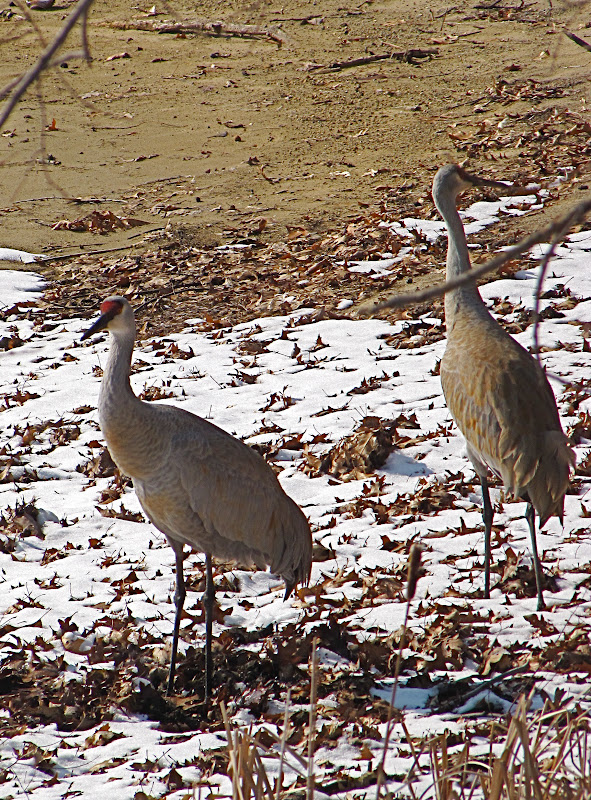
I was excited to happen upon a pair of Sandhill Cranes, the first I’ve been able to photograph, though these shots aren’t as good as my real-life excitement was. 

As I was returning to the car, I met a chatty sixty-ish couple with two dogs, one nasty, snarling Samoyan and one friendly mutt, black and tan, medium-sized. They told me I’d missed a bald eagle in the area where I found the cranes; they were not at all impressed by my cranes. The wife seemed to be saying, “Well, of course. Who hasn’t seen Sandhill Cranes here? Are you also titillated by sparrows?”
That doesn’t match the dark turn toward the end of Ted Kooser’s “Late February,” but maybe there’s a loose connection when the subject is the beauty and doom of northern winters
 
I’m not sure I’d break Kooser's last five words into two lines, as he does, and I cannot see those children bending “to the work/of building dams,” but every other image cracks with truth and, by the way, accuracy. They are amplified by Kooser’s typically soft-spoken understatement, restraint, and dignity, which make him trustworthy, reliable, not some histrionic showman. Snow patches like discarded laundry, children who look like old men, “blue TVs/flashing . . .  in picture windows” are remarkable in the way they blend clarity, vividness and calm. I also admire the subtlety of cornfields that are being staked for suburban development, another kind of winter, one more signal of the decline of farming.


The revealing of the farmer and the likening of that to a tulip are bold turns. At first I thought, “Whoa. Easy there, Mr. Kooser. Let's not leap to a TV crime show.”  But after a couple of readings, I've warmed to that concluding simile—it’s sudden, dramatic, vital, the opposite of the ennui in the poem’s first two-thirds or so. Isn’t that precisely the way tulips and spring’s rebirth begin? If discovering a months-dead farmer is dramatic, so is the new life that replaces him. For such a laconic midwestern poem, this is startling stuff—just as it needs to be if we’re to receive, and believe, Ted Kooser’s news about life, death, and high drama, even in Nebraska.


By the way, my fairy godmother or muse or Some-Being must have been looking out for me:  I had no intention of pairing Nebraskan Ted Kooser with Sandhill Cranes, but there it is—the Platte River Valley is a renowned layover for cranes in migration.  “For the cranes, the Platte River Valley is the most important stopover on this migration. The river provides the perfect spot to rest, and the nearby farmlands and wet meadows offer an abundance of food. Without the energy gained along the Platte, cranes might arrive at their breeding grounds in a weakened condition—where food may be limited until the spring growing season begins.”  For more on cranes:  http://www.rowesanctuary.org/crane%20facts.htm

  Late February by Ted Kooser : The Poetry Foundation

Feb 23, 2012

Kevin Young's “The Mission” and Emily Dickinson's "I Heard a Fly Buzz"

The Mission by Kevin Young : Poetry Magazine


A useful, non-academic, good way to try to love poetry might be searching our own experiences for something similar to the poem we’re reading—better yet, a poem we remember and wonder why.
I suspect something like that is going on in Kevin Young’s excellent poem, “The Mission,” in which he’s remembering a funeral home across the street from his own place, probably in his youth. Those funeral scenes, homey and comforting in their way, remind him of Emily Dickinson’s “I Heard a Fly Buzz (465),” which gives him his closing line. (I was also thinking of “There’s Been a Death in the Opposite House,” discussed here last March— Banjo52: Emily Dickinson, "There’s been a Death, in the Opposite House").

I heard a Fly buzz – when I died –
The Stillness in the Room
Was like the Stillness in the Air –
Between the Heaves of Storm – 

The Eyes around – had wrung them dry –
And Breaths were gathering firm
For that last Onset – when the King
Be witnessed – in the Room – 

I willed my Keepsakes – Signed away
What portions of me be
Assignable – and then it was
There interposed a Fly – 

With Blue – uncertain stumbling Buzz –
Between the light – and me –
And then the Windows failed – and then
I could not see to see – 

Among Kevin Young’s insights or propositions that I find intriguing is his finding in those funerals across the street “less/disquiet than comfort” as “the street filled with cars/for a wake.” How might he, or we, find a wake or a funeral across the street comforting? At the end, he doesn’t want the cars to pull out and drive away; instead he tries, like a child, to achieve or recover darkness by putting his hands over his face. 
Is it, ironically, in darkness and death, in hiding from a sun “too bright” that the speaker finds permanence, stability, and in that a comfort in which things and people, such as his father, no longer leave him? In fact, at a funeral, they cluster and stand in their inexpensive suits, gathered perhaps for the very sake of comforting each other and, unwittingly, the child or young man across the street. 

Another question:  a few lines into the poem, Young refers to “the sun/of the Mission,” which is the poem’s title. How should we read that and make it part of the poem, especially with “Mission” capitalized? Is the Mission life itself, or the satisfactory exit from life, with its excessive sun? Or is it something entirely other than that? 

In any case, “The Mission” is another of those works that satisfies the requirement that a poem be a gift and give us gifts along the way. Call it scattered candy if you like (big chunks of hot dog would suit me better—bread crumbs might be too humble, too dry). There are various elements in a good poem that pull us through it—happily or at least without coercion. They make us want to return, or they simply don't allow us to forget.


The Mission by Kevin Young : Poetry Magazine

*

Lovers' Lane