Showing posts with label Nathaniel Hawthorne. Show all posts

Nov 26, 2009

Imagining America, Continued: Hawthorne, Artists and Intellectuals

Honing his craft


He embarks. (Could be Robin in Hawthorne's "My Kinsman, Major Molineaux")


In response to my November 17 post on Individualism, Paula wrote:

“I'm very sleepy so maybe I shouldn't tackle this but it occurs to me that without Mozart we would simply have something else, most likely good and possibly better. I'm more interested in how people respond to the works than the works themselves anyway.

"Artistic geniuses like Glenn Gould are often so tortured and their lives so unhappy and I'm no fan of romanticizing the creative process, too many family and friends hurt and damaged. Sometimes taking care of your family is a deeper and more important creative act than being a noted musician or poet. I'll know more when I wake up in the morning.”


I think Paula hits on an important pair of ideas. The problem with the point on Mozart, of course, is that we can’t know what might have been. Odds are that Paula is right, but we’ll never know because Mozart did happen. I guess I find it tantalizing to wonder about the “what ifs,” even when I know I’m setting myself up for frustration.

Paula's second point is scarier: art versus life, one of the old, old questions. How do the major talents know they’re major talents and therefore “have permission” to choose art over life and other humans? I realize that borders on a false dichotomy, but I'm throwing it out there anyway. Also, I’m sure that very few young artists (I mean in all fields, including literature) would claim to know their greatness, their long-term significance; if anything, they’d probably tend to say it’s all a scary adventure, but one on which they must embark. The urge will not leave them alone; they don’t choose the urge—it chooses them. Even if that sounds a little LaDeeDah, I can’t discount it. Given the odds against being the next Emily Dickinson, in one’s own lifetime or in eternity, why would anyone choose that path? Arrogance is one answer; lack of alternatives is another. Most likely there are more, but I'm not sure any of them offer foolproof health insurance.

At best the young artist has to make the proverbial leap of faith into another kind of religious pursuit. However, that may be a leap into Self more than an exploration of the mysteries of being, of the Universe, of Spiritus Mundi, of gods and such.

At worst, it stops at plain old self-indulgence. Still, from a handful of such adventurers, we strangers benefit decades and centuries later—not because the artist particularly wanted to help us out, but because he wanted to explore and express himself and his world because it was the only thing that felt good, felt right.

PART TWO TOMORROW, NOV. 27, 2009

Nov 24, 2009

Nathaniel Hawthorne, American Heritage


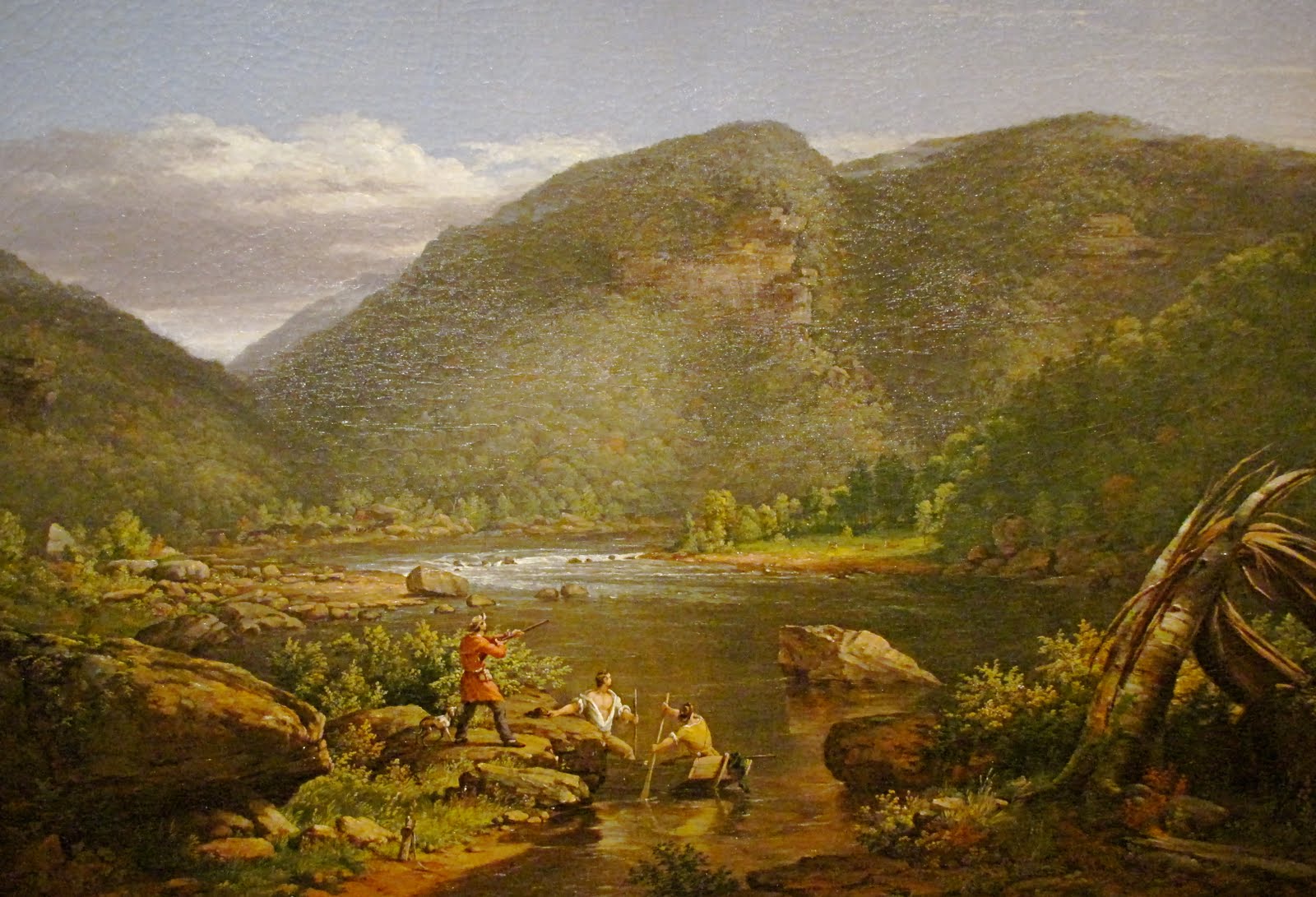
I’m pretty sure it’s not cool to like nineteenth American art, but in my last two visits to the art museum, I wandered into those rooms and was taken by much of what I saw. More and more often in looking at history, I think, “These are my ancestors. What do we have in common?”

My sense of connection also arises partly because of Hawthorne’s story, “Ethan Brand,” which has popped up in conversation a couple of times lately; his unflattering portrait of New England villagers intrigues me.

Ethan Brand left his town eighteen years before the story begins. Now he’s back, and the town’s atwitter about his return. We learn that he left in order to discover “The Unpardonable Sin,” and, guess what, he found it. It’s the sin of pride that causes someone to set himself apart from, and therefore above, “the brotherhood of man.” By seeking the Unpardonable Sin, Ethan Brand commits it. He knows it, and says he would do it again.

Labeling the seeker, the rebel, the iconoclast an “unpardonable” sinner—that sounds like a pretty democratic and reasonable value system, right? But when we meet Ethan Brand’s fellow citizens, we’d consider lighting out for the territory too. They tend to be drunk, ugly, and uninteresting, except that they’re sort of weird, sort of a traveling circus that doesn’t travel.

So are we supposed to identify with the arrogant “intellectual” and title character, who says he's not repentant for his self-imposed exile, which amounts to self-exaltation? Are we up to it, that kind of defiance, solitude, and acceptance of responsibility? Or should we see ourselves as one of the tedious, unattractive Everymen of the village? At least the motley crew in the town square have each other—right? Is that what we’re supposed to say, out of a sense of modesty and a need for others, a sense of ourselves as herd animals? The townsfolk are the only alternatives to Ethan Brand in the world of the story; so to play fair, those are our choices.

“Ethan Brand” is my favorite Hawthorne story, along with “My Kinsman, Major Molineaux.” I think both pieces ask more complex and subtle questions than most of his work does.

So when I saw the paintings, which are roughly contemporary with Hawthorne, I couldn’t help but see the rag-tag bumpkins of those two stories, or the pious folks of Salem who render Young Goodman Brown an isolated cynic in one of Hawthorne’s other famous stories.

If the humans in these paintings are our norm, the best or only prospects for fellowship, how do we respond? To which male would you hand over your daughter? Which female looks like the best candidate for interesting talk over coffee? Or is coffee not the point? If these are our predecessors, who are we?

* * *

Lovers' Lane