Showing posts with label Robert Frost. Show all posts

Oct 10, 2013

e.e. cummings, Robert Frost's "Design" and Politics 2013

Design by Robert Frost        

Robert Frost’s Italian sonnet, “Design” is somewhat similar to e.e. cummings' English sonnet, “When Serpents Bargain”   (when serpents bargain for the right to squirm... (22) - Poem By E. E. Cummings - Read Classic Poetry Online) in asking questions about the nature of animals, humans, and the possibility of order in the universe. “Design” tends toward philosophy while “When Serpents Bargain” is a satire on the legal and commercial dealings of humans.

Strangulation in High Places
But both poems convey dark themes softened by lightness, innocence, playfulness in language and tone—more so in “When Serpents Bargain” than the grimmer study of animal behavior and the possibility of cosmic chaos in “Design.”


In my October 2 post on cummings’ “When Serpents Bargain,” I mentioned that I’d been a little cantankerous about the poem back on April 7, 2011.  (No pressure, but it’s here if you’re interested: 

(http://banjo52.blogspot.com/search?q=when+serpents+bargain).

Although I share cummings’ dim view of human wheeling and dealing, in which every serpent-of-a-person is trying to sell a used car in bad repair, it might be childishly romantic (reverse narcissism?) to think we’re crazier than critters in nature. 
Congress
We might be trying and failing to deal with complex matters of morality and law (witness our present situation in the U.S. Congress), 
but animals solve their diplomatic problems by eating each other. 
Gunboat Diplomacy

Also, when an animal fails, he dies alone in the field for lack of medical care or food. Birds fall out of the sky. The philosophizing, lawyer-izing verbiage that cummings mocks in “When Serpents Bargain” is our spastic effort to avoid eating each other or dying alone in a field. 

Maybe the animals’ free-market way is good for Republicans, Libertarians and anarchists, but me, I’ll take the modified welfare state, yes, the Nanny state. What’s wrong with nannies? They’re paid to like us when our parents are too busy or too mean for liking. They're paid to be kind. When we get a haircut, we don’t bellow about The Barber State, do we?

I prefer the limited version of Nanny State that encourages earning our victuals and our pleasure, but let’s not go all Tea Party and dump people on the curb to bleed out if they fail or get sick. Alone. Except for the Tea Partier, who is the stranger standing over the fallen man and chanting Bible verses or Christian rock music. The guy on the curb needs macaroni, not a parable. 


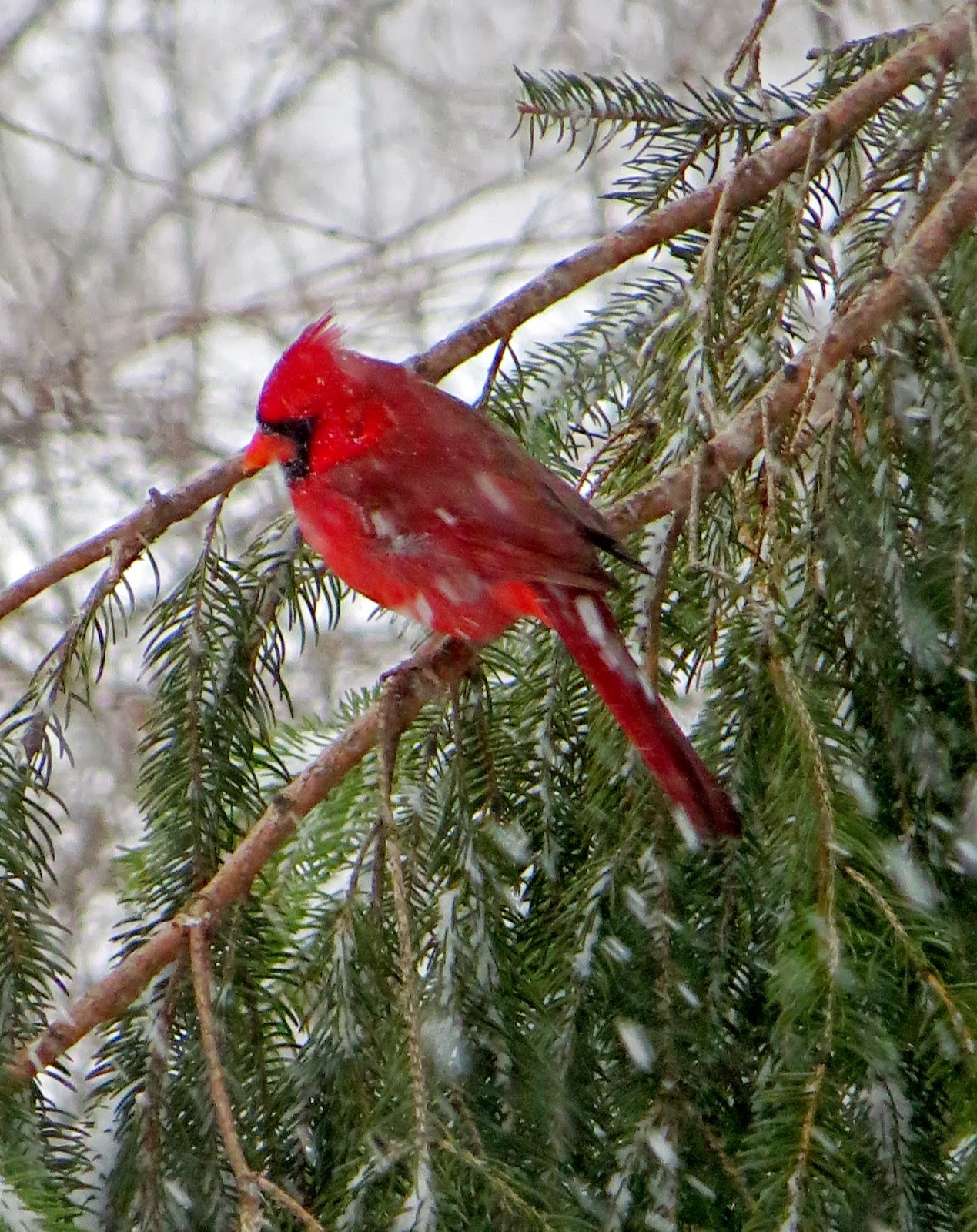
Maybe the heroic cardinals have it right. A couple of years ago I mentioned here my cardinal couple, who, for about a week, adopted and fed, beak to beak, an orphaned white-crowned sparrow chick, in my back yard.
Steadfast but Pondering

Tom, my most hard-core evolutionist friend, thinks I’m lying about that. He said, “But John, I don’t see the evolutionary advantage in [the cardinals’] behavior.” As gently as possible, I said, “That’s the point, Dumbass!”

I restrained myself from going all Hamlet-and-Horatio on him, but I was on the verge of reminding Tom that “there are more things in heaven and earth, Tom, than are dreamt of in your philosophy.” (Everyone should have a friend named Horatio. Look what he did for Miami forensic investigations). 

By the way, my friends and I regularly refer to each other as Dumbasses or worse. That’s one thing I like about us. We tell the Truth on those rare occasions when we can find it. On the other hand, each of us thinks he’s found Truth way more often than he has. I suppose that makes us pretty Tea Party-ish. Once again, irony thrives, even in a world full of blinders and misguided faux earnestness.
Self-Strangulation


The fact remains, I witnessed those cardinals for several days as they fed the Other, the alien, who might grow up to compete with them for food. I called the local Audubon Society, which confirmed that such charity happens in the animal kingdom, and yes, cardinals are among the chief do-gooders. Nanny Cardinals. Baby sparrows.

*

Aug 21, 2011

Robert Frost, "The Draft Horse," William Logan, Literary Criticism and the Power of Thought


I write this in the wake of some schools’ (cowardly?) surrender to ignorant, cowardly parents (and, remarkably, one college professor) who have supported or caused the banning of Vonnegut’s Slaughterhouse-Five and/or Twain’s The Adventures of Huckleberry Finn.  I assume such parents fear their children will be led to thought, among other disturbing experiences, like laughter, kindness, friendship, along with a distaste for hypocrisy, war and bigotry, both personal and institutional.

I also write this with thanks to William Logan (see this blog,  June 2, 4, 7, 26, 2011) and The New Criterion magazine for directing me to an intriguing Robert Frost poem I had never seen.  

 Frost's horse, Wilbur's ride by William Logan - The New Criterion

THE DRAFT HORSE by Robert Frost

With a lantern that wouldn't burn
In too frail a buggy we drove
Behind too heavy a horse
Through a pitch-dark limitless grove.

And a man came out of the trees
And took our horse by the head
And reaching back to his ribs
Deliberately stabbed him dead.

The ponderous beast went down
With a crack of a broken shaft.
And the night drew through the trees
In one long invidious draft.

The most unquestioning pair
That ever accepted fate
And the least disposed to ascribe
Any more than we had to to hate,

We assumed that the man himself
Or someone he had to obey
Wanted us to get down
And walk the rest of the way.


I’d think “The Draft Horse” would spark good classroom discussions, with questions pouring from teachers and students alike.

Who is this strange couple, who speak so dispassionately about such a traumatic, mysterious event? Do they represent more than their old-timey,  agrarian selves?

Why is the assailant so anonymous and motiveless to the victims, as well as the rest of us?  

Isn’t there the feel of third person point of view, even though first person plural (“we”) is made clear in the second line?  If so, how does Frost accomplish that feeling of an omniscient perspective, and what might it add to the poem? 

Can a grove be “limitless”?  Isn’t a grove a somewhat small cluster of trees?  Is “ponderous” an okay choice of words?  Who would use it, and therefore what does it say about the narrator? 

“In one long invidious draft”—isn’t that rhythm rather awkward?  And, like “ponderous,” isn’t “invidious” an word in a poem and speaker from rural America?  “Any more than we had to to hate”—that’s natural, even folksy speech, yet it’s likely to make a reader pause at “to to” (16).  Is that okay?

If “The Draft Horse” is as teachable as I suspect it is, why is it not included in more anthologies?  Is it so ambiguous that teachers (and editors)  don’t have a comfortable number of definitive answers for student questions?

Does the poem challenge mainstream, submissive, unquestioning behavior, such as we see in the victims, who squirm at any notion of hatred?  Would too many of us, including teachers, be forced to acknowledge that we are similarly “unquestioning”—so much so that we assume a horse-murdering assailant merely wanted us to walk instead of ride in our “frail” buggies?  Or that he was the agent of someone, or some force, too powerful to investigate? 

Are those questions too uncomfortable to inflict upon American teens and their teachers (and then their angry, litigious parents who might complain that a mere poem has agitated Jimmy and Susie, made them nervous or irritable table companions)? 

I suppose that’s far-fetched . . . .  

I highly, highly recommend William Logan’s analysis that surrounds the poem in 
The New Criterion. I don’t know if I’d go where he does on Christianity or the importance of horses in America, but his arguments are always an interesting, fine example of what’s good about high-caliber literary criticism. First, it chooses a subject that deserves careful attention. Then Logan avoids glossing over things; he looks at details and provides thoughtful responses to them. His language is professional, but not ostentatious or forbidding.

I don’t expect anyone to take me up on reading Logan, but for what it’s worth, I find it an extremely worthwhile, important kind of thinking, and I look forward to reading what he has to say about Richard Wilbur in the second half of the essay.

Frost's horse, Wilbur's ride by William Logan - The New Criterion

**

Apr 1, 2011

Robert Frost, "Desert Places," Mental Health, Politics, Baseball


Desert Places by Robert Frost

To follow up just a bit on the subject of mental health in Hirsch’s tribute to Christopher Smart and my challenge concerning John Boehner, here is Robert Frost’s “Desert Places, ” a fairly well-known poem that I like all right but do not love. Desert places of the mind—probably indicating depression or at least gloomy perceptions—seem a fertile subject (ironically?); we’ve all been there, I suspect, at least briefly . However, Frost’s attempt to convey that emptiness feels somewhat blank as a poem.

The imagery is clear enough, and a couple of phrasings are moderately interesting. For example, there’s the odd but effective notion of possession in “The woods around it have it”; the trees OWN the whitening field, and that’s a new, interesting take on a snowy winter field at night. Also, I feel as well as understand the expanse of a night’s white field when it’s compared to “empty spaces / Between stars.” The size and silence of the vacuum increase if we imagine space; both the white field and black sky are vast, quiet, and unwelcoming, if not forbidding.


But the rest of the poem fails to reach out and grab me by the throat; nothing puts me in that haunting field. Because I’ve seen such spaces a hundred times, a poem about them needs to offer something new, while at the same time confirming that the poet and I have shared this experience. Frost offers little or nothing fresh on his subject. Even the title’s “Desert” seems obvious and maybe trite, maybe forced—not to mention its working against the central landscape, which is snowy, not sandy. It’s as if I hear the writer as he thinks, “Let’s see, how many blank things can I think of, besides a snowy field. I know! A desert!”

The poem’s music is noticeable, but not hypnotic or otherwise engaging—the way it is in “Stopping by Woods” or “Acquainted with the Night” or "Nothing Gold Can Stay," to mention only three musical wonders by Frost. And, still concerning music, some of the rhymes feel forced—how about “last” in line 4? Or “unawares” in line 8? Or their overall simplicity and loudness?

Moreover, the rhymes simply aren’t particularly interesting; we readers don’t feel nudged into unexpected word and thought combinations because the poet hasn’t offered them, hasn’t put us in the midst of surprising but apt pairings—he hasn’t demanded that, from time to time, we hear, see, experience things anew.

As a final complaint about language, I notice a variation on “Lonely” is used four times in three lines, while “no” and “nothing” along with “express” and “expression” occur within two lines. All this strikes me as mere repetitiveness, rather than a scary echo in the night field.


Robert Frost has written so much great poetry that he doesn't have to worry about opinions at Banjo52. But more to the point, I’ve said aloud at times that no poet has more than 20 poems we all might label “great.” So I offer “Desert Places” as an occasion to step back and remember that even the icons are human. Quite possibly none of them batted .300, and baseball is considered a game of failure, in which a 30% success rate is noteworthy. I guess the same could be said of politicians; but their personal and public "desert places," their bad days, mistakes and deceptions, can cost way too much for way too many people.

Desert Places by Robert Frost

**

Jun 15, 2010

Robert Frost, "Design"

Northern Parula Warbler and Yellow-rumped Warbler, Magee Marsh in NW Ohio: sitting pretty, scanning for food, mate, territory, and nerds with long lenses.


Here is Robert Frost's sonnet, "Design," which I offer as a comparison to Sunday's Lux poem. It's probably not debatable that the Frost is denser and verbally more complex, including the rhyme, meter, and the tradition of the sonnet. Is it therefore a better poem? Is its philosophical content larger, more substantial, more complex, more legitimate? Is its language more pleasing or more compelling than Lux's? If Lux's monkey poem is better, what makes it so? (And "better" is not the same issue as "I like it more." Your mom might be prettier or wittier than my mom, but is she a better mom?).


Design - Poets.org - Poetry, Poems, Bios & More

Jan 12, 2010

Why I Am Not a Painter by Frank O'Hara : The Poetry Foundation [poem] : Find Poems and Poets. Discover Poetry.


Why I Am Not a Painter by Frank O'Hara : The Poetry Foundation [poem] : Find Poems and Poets. Discover Poetry.


A South Carolina guy, might be headed for the diner.


Today’s poem and comments began as a response to Barbaro’s recent response to my January 8 and 9 postings of Dickinson and Frost poems. Also, another regular, Gothpunkuncle, has in the past given me food for thought about the importance of context and culture compared to language (not that he’s choosing one over the other any more than I am). So after Emily Dickinson and Robert Frost, I turn to Frank O’Hara’s “lunch poems.”

It all began like this, my attempt to respond to Barbaro on January 9:

Barbaro, your sentence on simplicity is LARGE. I agree, though I feel as if I’ve seen a lot of poetry that falls flat in the name of simplicity—which illustrates your very point.

Ditto your sentence on saying things wrong, more or less as a definition of creativity or originality. Didn’t you make a similar point about Bach a few months ago?

I can live without E.D.’s dashes, but I agree, it’s not the same. (By the way, did you see Paula and Gothpunkuncle’s important January 8 comments about Dickinson’s life and times? They gave me pause, not that I ever thought she was having a party for one up there in her Amherst room).

Thanks for the technical info too, Barbaro. At least on this reading, I had not noticed the sonnet biz in "Acquainted with the Night."

Do you think the experimental stuff in today's poetry—the stuff that seems to be re-examining language and old structures—ignores the endless possibilities of traditional forms? How many ways can you stretch a sonnet? More than a couple.

As you know, I’m not at all a bigot against free verse, and you might know I believe in the old saw, “If it works, it works,” for all the dangers there. But until the recent (and still minority) tilt toward neo-formalism (if that’s what they call it), I guess I assumed that some of the edgier poetry, the wilder, hipper-yet-more-talky voices out there, would have sent me to the children’s play room if I’d asked why they were transmogrifying poems into chatty prose, the likes of which I can hear at most diners.

Not that there’s anything wrong with diners. Some of my favorite food is served at diners--and certainly some of my favorite experiences. I often meet friends at diners. Our conversations can get pretty good, pretty deep, even pretty close to the bone. But I’ve never called them poetry.

Why I Am Not a Painter by Frank O'Hara : The Poetry Foundation [poem] : Find Poems and Poets. Discover Poetry.

Jan 9, 2010

Acquainted with the Night by Robert Frost : The Poetry Foundation [poem] : Find Poems and Poets. Discover Poetry.


For some obvious reasons and maybe some more subtle or inexplicable, I've recently thought of this Frost lyric as a sort of companion to Dickinson's 510. I hope somebody will elaborate, pro or con.

Also, "Acquainted with the Night" is another poem that has more power for me than I can explain--something about a chant in the rhythm, I think. And in the third stanza, it gets intense and stays intense, don't you think?

I'll try to get to brighter stuff soon, but maybe you'll agree that if we're going dark, these two do it well. Yet a lot of people probably think of Dickinson and Frost as founding members of Hallmark Cards or SADP (Students against Dark Poems) or MADP (shut up, Banjo).

Acquainted with the Night by Robert Frost : The Poetry Foundation [poem] : Find Poems and Poets. Discover Poetry.

* *

Nov 1, 2009

Poem of the Day: Frost's "Nothing Gold Can Stay"


NOV. 1, 2009

Last Thursday, October 29, you saw at this site a late October scene at a maple-rich, golden Michigan park, photos taken that day. As if to prove Robert Frost’s simple but great title, “Nothing Gold Can Stay,” here are some of the same spots in that park today, three days later, after a little wind and rain on Friday. How can these trees know or care that the human calendar says we’ve entered a new phase?

To top it off, I saw Bambi’s ma and pa today, but not long enough to get a photo. They flashed across a path, into some trees, and in seconds went invisible. It also occurred to me that Daddy Bambi, 6-point buck, might want to face off with me, and I didn't want to embarrass him with my latest martial arts moves.

I’ve lived east of the Mississippi and north of the Mason Dixon line most of my life, but it still stuns me every year how fast “dawn goes down to day,” as Frost says. I do see in these shots that November has its pleasures. But on the whole autumn color is a tease; love it, maybe, but never trust it.


Here is Frost’s poem:

Nature's first green is gold
Her hardest hue to hold
Her early leaf's a flower;
But only so an hour.
Then leaf subsides to leaf.
So Eden sank to grief,
So dawn goes down to day.
Nothing gold can stay.

* *

Lovers' Lane