Showing posts with label Yeats. Show all posts

Apr 25, 2013

Rainer Maria Rilke, "Archaic Torso of Apollo," trans. Stephen Mitchell

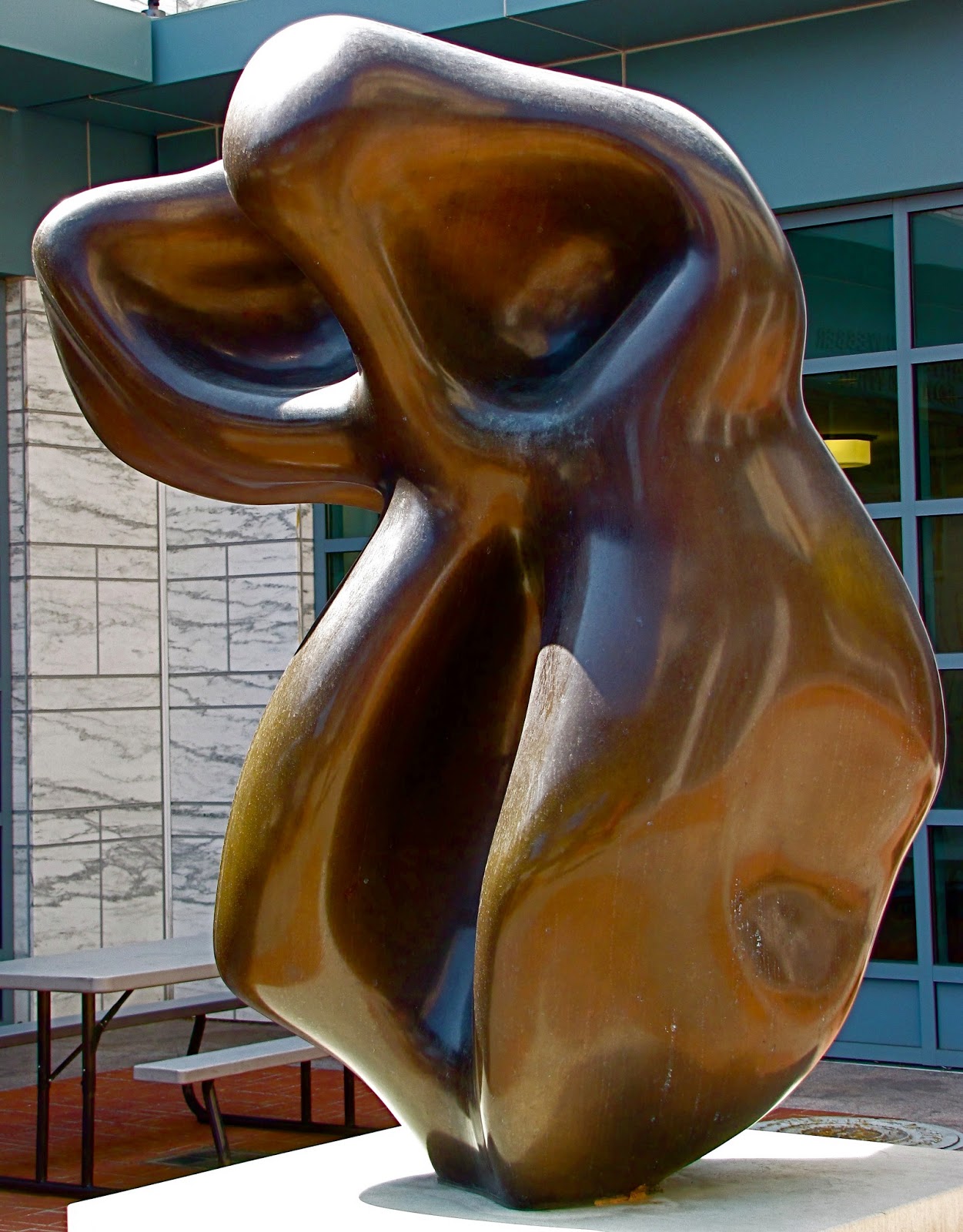
Arp, Torso of a Giant, 1964, D.I.A.
I hadn’t read Rilke’s “Archaic Torso of Apollo” in a long while, and frankly I’d forgotten about it. That's shameful, but instead of leading vapid, jejune cheers about the poem and its perplexing conclusion, let me simply admire a few of its particulars.


First, let’s note that it’s an Italian (or Petrarchan) sonnet, fourteen lines that begin with a rhymed octave (8 lines) to which a 6-line, rhymed sestet responds in some way. So it’s a bit similar to an English (or Shakespearean) sonnet’s concluding with a rhymed couplet that responds to its preceding twelve lines.

How translators manage to preserve any kind of rhyme has always impressed me. I’ve read somewhere that a good translator often has to make the choice of what’s primary—the poem’s content, including literal translation, or its formal characteristics such as rhyme and meter. At any rate, that kind of intelligence is magic to me, so hats off to Stephen Mitchell.


Apollo was the god of truth and light as well as music, poetry, and some other good things, and as foil to that loosey-goosey, hell-raising frat boy, Dionysus. I think of Apollo as the god of reason and moderation.  So the figure of a decapitated Apollo might suggest an entirely physical, animal power (“like a wild beast’s fur”) with too little wisdom or soul to “burst like a star” “from all the borders of itself.” The thinking god has lost his head.

The danger of a god’s sexual power might feel menacing us, especially as we remember Zeus' rape of Leda, the mortal, who gave birth to the child who would become Helen of Troy, and be partially responsible for a ten-year war, as her Greeks tried to retrieve here. But in Rilke's Apollo, we perceive “a smile” running “through the placid hips and thighs /  to that dark center where procreation flared.” Even there, at the “dark” sexual center, which might be anarchic power in an animal or human, the god’s internal “brilliance . . . like a lamp” illuminates and “dazzles”; he's  empowered with the light to see everything we do, even without his head.

Here, I'm reminded of Yeats’ “Leda and the Swan,” another knockout sonnet, which concludes by wondering if mortal Leda takes on the rapacious Zeus’ “knowledge” with his power before “the indifferent beak could let her drop.” And there’s James Wright’s memorable, disturbing conclusion to “Lying in a Hammock”—“I have wasted my life.”  I wonder if Yeats and Rilke, as contemporaries, were consciously or unconsciously influenced by each other. And did the younger James Wright owe a debt to Rilke's  sonnet?

Here’s a little game to play:  put Rilke’s first and last lines together, and we get “We cannot know his legendary head. . . . You must change your life.”  Apollo’s “legendary head” is missing from the sculpture, so in both literal and figurative ways, we cannot know his inner life. 
More importantly, we cannot know it because we are mere mortal schmucks. Light does not explode from our torsos and make our dark crotches glow with smiling benevolence. Maybe most of us would rather come across as Darth Vader anyway. 

But how shall we change our lives—to be more like the god or to be more submissive to him? Shall we try harder to emulate Apollo’s light, though we know it’s a doomed effort? (Maybe Sisyphus thought so as he rolled his rock up the hill). 
Or, since we cannot be immortal or comprehend divinity, should we become more modest and submissive, accepting the limits of our puny knowledge and the sinister darkness of any power we have?

Are there third and fourth and twentieth ways to read Rilke’s last line?

My thanks to poet and professor Carol Muske-Dukes for returning me to Rilke’s sonnet, which she discusses from a different perspective in her essay, “What Is a Poem?” (in The Eye of the Poet: Six Views on Craft, ed. David Citino). 

We should remember that the purpose of literary criticism and scholarship is leading well-intentioned readers from one worthy poem, poet and idea to another. Too often the whole enterprise is debunked as academic charlatanism, the smelly alley to tenure, promotion, and ego-enlargement within The Academy. 

To be sure, some of it is that, but much of it consists of one well-lit head shining a light for others who want to know . . . and accept the fact that they need to know. 


Jul 14, 2011

Yeats' "The Circus Animals' Desertion": Back to Basics

Now that my ladder's gone,
I must lie down where all the ladders start
In the foul rag and bone shop of the heart. 

 
My circus animals were all on show,
Those stilted boys, that burnished chariot,
Lion and woman and the Lord knows what.


Yeats’ “The Circus Animals’ Desertion” is like Lowell’s “Skunk Hour” in the way the voice shifts from personal to public, then back to the personal.  In this case, the poet himself is aware of his change in tone; he actually divides a one-page poem into three numbered sections, each in a voice that's different from the other two.

"The Circus Animal's Desertion" - The Poem


I’m somewhat interested in the first section, but the second and longest section, which reviews the poet’s career in a somewhat detached, academic, public way, leaves me cold. If a reader is not fairly familiar with Yeats’ oeuvre, how is he to understand or care about the specifics in Section II?   Furthermore, the language, in spite of being self-deprecating, feels rather clinical, as it conveys an equally detached summary of Yeats’ plots, themes, tropes and strategies over his writing career.

But in Section III, we return to real people and their issues, which are both specific and universal—especially the awareness of encroaching old age, decrepitude, and death. Reviewing a life, how shall a writer, how shall any of us, confront the need to keep reinventing ourselves, our work, our sense of purpose? It is an intensely personal matter, and it requires a personal language if it's to ring true.

Themes of the embittered heart, or so it seems,
That might adorn old songs or courtly shows;
Yeats’ answer comes right out of the streets. It is urgent, visceral, and full of basic human concerns. It has not one iota of academic or public distancing. That old ladder is gone; it is now too late in life to call upon those same circus animals that once danced, performed, deluded, distracted. How can anyone feel distance in these lines, which challenge us all, from the perspective of raving sluts and garbage in the street? 

If we look back and review our own lives, and find them full of frippery, what then? Lie down and begin again, where all the ladders start—in the “foul rag and bone shop of the heart.”  Stamina, courage, integrity, work—they’ll wear us out, they’ll make us stink, but no other way means anything.

"The Circus Animal's Desertion" - The Poem

 
Those masterful images because complete
Grew in pure mind, but out of what began?


Jul 7, 2011

"Leda and the Swan": Closure, Cymbals and Dragonflies

The other day, I stumbled onto one of Yeats’ most famous poems, “Leda and the Swan," in which Zeus, disguised as a swan, swoops down and rapes the entirely human woman, Leda. From that union, Helen of Troy is born. 

Leda and the Swan- Poets.org - Poetry, Poems, Bios & More

Yeats’ ominous conclusion, masquerading as a question, made me think about endings in poems, including Robert Lowell's "Skunk Hour," discussed here July 1:

  a mother skunk with her column of kittens swills the garbage pail.
  She jabs her wedge-head in a cup
  of sour cream, drops her ostrich tail,
  and will not scare.

We’ve heard, at least from Princeton’s James Richardson, that a poem should end standing on one foot.  I think he means that poems’ endings should avoid a bass drum message and clang of truth-cymbals implying that the rest of the poem hasn’t been worth much, has mostly been a charade that was only meant to prep for the fat lady's song of Truth as the curtain falls.

Here again is Keats at the end of “Ode on a Grecian Urn”:
'Beauty is truth, truth beauty,—that is all   
    Ye know on earth, and all ye need to know.'
I tend to agree with James Richardson; poets should not moralize bombastically or condescendingly to their readers. But I excuse Keats here because:  he was Keats; he was young (25); he was writing under a different aesthetic (English Romanticism, around 1819); and I probably agree with his aphorism—Beauty (capitalized) probably is as close as we can come to Truth.

But as I tell myself I want poems to end with a touch of humility, obliqueness, standing on one foot, I think too other endings of poems.

Would I want these or “Leda and the Swan” muted, turned sideways, forced to wobble on one foot, pretending to be tentative about any Truth they offer?  
     Oh as I was young and easy in the mercy of his means,
         Time held me green and dying
       Though I sang in my chains like the sea. 
(Dylan Thomas, “Fern Hill”)


In me she has drowned a young girl, and in me an old woman
Rises toward her day after day, like a terrible fish.   
(Sylvia Plath, “Mirror”)

Or how about this chunk of magnificence from Richard Ford’s “Rock Springs,” a short story about a ne’er-do-well trying to set his ship aright, but for now, he's stranded in Wyoming:

What would you think a man was doing if you saw him in the middle of the night looking in the windows of cars in the parking lot of the Ramada Inn?  Would you think he was trying to get his head cleared?  Would you think he was trying to get ready for a day when trouble would come down on him? Would you think his girlfriend was leaving him?  Would you think he had a daughter?  Would you think he was anybody like you?
                                                                                                                (Rock Springs, 27)

These might not be great examples of ending on two feet; but if they are, maybe we shouldn’t be in such a hurry to ask for one-foot landings. The closures above present big music and state, or strongly imply, big Truths; if that renders the rest of the works insignificant by comparison, maybe we should ask for more from the beginnings and middles, rather than less from the endings.

My own jury on this, is, as usual, still out, enjoying fried chicken under a giant tulip tree. Besides, it's almost certainly a case by case matter. Does anyone out there feel strongly about this, one way or the other?

**

May 3, 2011

"The Wild Swans at Coole" and "Song of the Wandering Aengus" by W.B. Yeats (poetry reading)

"The Wild Swans at Coole" is okay, though not my favorite Yeats.  However, I think this reading of it is perfect, a comment you don't often hear from Banjo-grouch (see my extended complaints here last October 15 & 19, February 19-20) about the mosh pit of poetry readings and the Hollywoodizing groupie-grope poet-hugging that abounds therein (should there be a comma in there somewhere?).

Also, I just happen to have a swan shot or two.  

YouTube - "The Wild Swans at Coole" by W.B. Yeats (poetry reading)


Notice this elegant pair, who think they are somebody, swimming in mud, more or less, and pretending to be too symmetrical and lofty to care about food, while in the foreground three mallards manically bob for minnows, octopi, or corndog leavings.


Actually, I was misremembering. I was thinking of a Canada Goose in a setting I like. But you can have him too if you'll admit to liking "Song of Wandering Aengus" just a little. Last time this came up (November 28, 2010), only one of you rose to the occasion. (Do you know who you are?).

"Aengus" is an early (1899) Yeats poem that draws little enthusiasm from serious scholars or those readers of Banjo52 who are full of gravitas. I admit it's a bit sappy and perhaps too reliant on Gaelic mythology, but I like it anyway. Here is the same guy reading; maybe his presentation will sell the poem. That can happen.

YouTube - "The Song of the Wandering Aengus" by W.B. Yeats (poetry reading)

**

Feb 19, 2011

Coleridge Again and the Question of Group Poetry


So much for Elkhorn city. Back to poetry we go. I intend this to continue some of the ideas posted last Tuesday, February 15, so here again is Coleridge's "Frost at Midnight."

Frost at Midnight by Samuel Taylor Coleridge : The Poetry Foundation [poem] : Find Poems and Poets. Discover Poetry.

How important are quiet and solitude in the self-exploration and study of the world required for creative writing? After all, serious writers—even the funny or entertaining ones—are aiming for some kind of larger Truth, among other targets. (Don’t ask them to admit that; it sounds embarrassingly self-important. But good writers and good readers alike know it’s a fact).

So I guess my concern grows from the groupiness I see—or imagine—in today’s American literary scene, where M.F.A. programs and writers’ conferences proliferate like bacteria. Some bacteria are good for us, and I’m not about to argue against pairs or groups thinking and talking about what writing should and should not be. If you hear enough responses, your own amorphous answer will be forming, whether you want it to or not. (If it’s not amorphous, if you think it has solidified, it’s not the answer).

Also, I’m hearing over and over at conferences and readings how writers gathering at a site form a “tribe.” I’ve heard “You are my tribe” more than once in the last few years. I guess that’s guess cozy and supportive, but it also feels uncomfortably trendy.

(By the way, I'm not very worried about these tribes being exclusive—it’s anybody’s guess which came first, the tribes going off to their own corners, or mainstream society’s drop-kicking them there).

So, yes, writers and artists are isolated, under-valued people who need group support, a sense of family, and a community of benevolent but frank critics. What I see or imagine at these events is a social bonding that might be worthwhile and reasonably honest, but is also deceptively kind—students and teachers alike. It feels like collective flattery, an inflated, artificial sense of excellence and self-importance among beginners and veterans alike. I'm not sure when meaningful collegiality becomes frat-boy chumminess, but I think we ought to be asking the question.

Can I prove it's a problem? No, but I try to remember that the prolific Yeats, who is surely on everyone’s Top Twenty List, probably has no more than 20 poems that are indisputably great. Of the writers who are celebrity teachers at these events, how many have produced a body of work or single poem that will be read, remembered, studied, admired 50 years hence?

I say that only to add some realism and perspective to the discussion, not to be mean. The writers themselves are probably all too aware of how tenuous their current status is, but I'm not so sure about the students, who might be ages 18 - 80 at conferences. Are they grounded in the reality of how mortal their work probably is? And even the work of their esteemed mentors?

Around ten years ago, in some office, I came across a year's worth (1969, I think) of Poetry Magazine, then and now one of America's most prestigious places to be published. I was amazed to find that only about 5 - 10% of the poets represented in that year's twelve issues were names I recognized. Other, more serious poetry scholars and zealots might spot more, but even so, it's bitter food for bitter thoughts.

More tomorrow or soon.

***

Nov 28, 2010

Yeats, "The Song of Wandering Aengus"


The Song of Wandering Aengus, by W.B. Yeats


"The Song of Wandering Aengus" is early Yeats and at least a bit on the sentimental side. But I liked it as an undergraduate when I was first getting to know Yeats, and I still find it appealing--the music of the language, the unabashed romanticism of the story and imagery. Also, at Kensington Metropark today, where it was sunny and 40 degrees, I had some luck with chickadees, tufted timice, and nuthatches; looking at the photos reminded me of the poem. Aengus can have his fish if I can have the birds.

If you want to earn an A, you'll need to compare the Yeats poem to Keats' "La Belle Dame Sans Merci," posted here November 12.

The Song of Wandering Aengus, by W.B. Yeats

Nov 1, 2010

Election Eve with W.B. Yeats and e.e. cummings


The two poems below acknowledge Election Day tomorrow. I was going to post words of my own, but they turned out rather grumpy about people from the other village (need a reminder about village people? see Oct. 27). The other village that wants to put paranoid hate-mongers in the C-place and substitute soundbites for reasons and phantom thrift for generosity, compassion, the public weal.

So I’ll let Yeats and cummings do the talkin’, although the Yeats is quite grave and cummings, the old hippie, sounds oddly Republican, with his anti-regulation theme. (e.e., Old Buddy, My Man, serpents and other critters also eat each other).

Competition can be healthy. Sensible games can be played hard by sensible people, under sensible rules. But without guidelines and their own purity of intent, athletes at sunset can end up feeling stranded on alien notions of a field of play. They feel bad; they've learned nothing good.

The Second Coming by William Butler Yeats : The Poetry Foundation [poem] : Find Poems and Poets. Discover Poetry.

when serpents bargain for the right to squirm... (22) - A poem by e.e. cummings - American Poems

Aug 12, 2010

Yeats and Olds Continued, The Bird Lady, "Adam's Curse"


Maybe everyone has met a bird lady at least once in a lifetime. In a way, the woman in the photo doesn’t exactly qualify because feeding the pigeon nation was a first for her. She kept repeating, “This is the coolest thing I’ve ever seen in my life.”

Cynics might urge her to get out of the house more, but I liked her delight in a simple pleasure. Pigeons are probably no one’s favorite animal, but the sheer numbers of greedy, gluttonous birds were impressive, and the woman became a girl again.

Then, behind me, I heard a gruff male voice, a stranger with a thick Brooklyn accent: “Those birds shit all over the place. Somebody oughta shoot ‘em all.”

“Shooting Pigeons in Brooklyn.” Sounds like a Mickey Spillane title. But that was the guy’s comment, and I wondered what I’d done to invite it.

There are certain kinds of tough-guy language and behavior that suck the joy right out of October blue and laughing children. Sometimes I worry about making such statements myself, just as I worry about being too sappy at the other end. Good writers have to walk that tightrope, among others, every time they put pen to paper. (By the way, I've just learned that Mickey Spillane briefly worked as a trapeze artist).

Somehow that’s the kind of decision I was asking for yesterday in comparing Sharon Olds’ “Sex without Love” to Yeats’ “When You Are Old.” Compared to honoring the Yeats, I can probably explain much more thoroughly what I like or respect about the Olds poem—its boldness and ingenuity in making serial sex a metaphor for our condition in the universe, its brazen repetition, its Oldsian decisions about line breaks, its mix of the trendy and the ontological, and on and on.

But “Sex with Love” also strikes me as a chunk of gravel shredding ancient parchment. Yeats and others have a feel for sacred documents; they know how to lay palms upon it, or gently unfurl it. I don’t know if Yeats could be crass if his life depended on it. But maybe that means he couldn’t be realistic either. He paid for that.

Perhaps it’s in this context that I offer Yeats’ “Adam’s Curse,” about work and beauty, poetry and love. The casual elegance of its language might cause readers to miss the fact that it’s written in rhymed couplets. Apparently the poet followed his own directions and labored so hard that we sense only the graciousness of his lines, not the labor that went into them. Isn’t that what he said he was going for, that illusion of naturalness? I wonder if he’s been to Brooklyn.


Adam’s Curse by William Butler Yeats : The Poetry Foundation [poem] : Find Poems and Poets. Discover Poetry.


**

Nov 7, 2009

A Touch More on Yeats


Apse mosaic at Sant-Apollinaire in Classe


I worry about overkill in my posts on poetry, especially the last two, where I hope to show or remind people of the richness of language when poetry is done well, even in a seemingly simple work like "The Cat and the Moon." Though I realize the technical talk runs the risk of pushing people away, my hope is to send or return folks to poetry. In spite of all the readings, conferences, and MFAs in poetry, it remains an art in need of a much broader fan base.

With no plan for my next entry, let me use an Altadenahiker question as the entry to a short post for today (I heard that sigh of relief . . . ). In the latest visitor comments, AH asks, “What's your favorite Yeats?"

Without looking at a table of contents, the Yeats poems that leap to mind are "Sailing to Byzantium" ( http://www.online-literature.com/yeats/781/) and "The Second Coming" (http://www.online-literature.com/yeats/780/).

But the last stanza of "The Circus Animals' Desertion," is also superb, I think, especially the final two lines. It’s one of Yeats's last poems, in which he summarizes his career, its themes, important characters and tropes. Frankly, I find the middle three stanzas rather tedious. But the first stanza is excellent, and all of it sets up this conclusion:

Those masterful images because complete
Grew in pure mind, but out of what began?
Old kettles, old bottles, and a broken can,
Old iron, old bones, old rags, that raving slut
Who keeps the till. Now that my ladder’s gone,
I must lie down where all the ladders start,
In the foul rag and bone shop of the heart.


* *

Nov 5, 2009

YEATS’S “THE CAT AND MOON” AND THE NEW CRITICISM, PART 2


First, let’s talk about the music in “The Cat and the Moon,” the rhythms produced by its meter. Most of the metric feet here are quite audibly iambic: “The CAT went HERE and THERE,” or “The CREEPing CAT looked UP.” But several anapestic feet find their way into the dominantly iambic music. The cat’s very name begins with an anapest: (min-a-LOO-she: short, short, long—that is, two unstressed syllables followed by one stressed syllable).

Over the course of one line or several, anapests are often considered a waltzing rhythm (dah dah BOOM). Here they are only scattered, but if we add to them the “loudness” of the iambs and the shortness of the lines—which means we hear the simple rhymes rather often—the poem develops quite a musical quality.

To my ear and mind, these sounds are prominent enough to echo a children’s tale or maybe something like an adult nursery rhyme. The conspicuous music could even suggest a child speaker, but some of the more ominous lines make that unlikely. What child would say, “troubled his animal blood” or “The sacred moon overhead / Has taken a new phase”?

So what we have is the appearance of a simplicity in the poem’s simple story: a cat moves in a dance-like way in the moonlight. But other lines and images bring adult complexity into the perception of the scene. Here’s another example: “. . . the moon may learn, / Tired of that courtly fashion / A new dance turn.”

To the extent that the music feels innocent or childlike, there is irony. It might seem that we see sweet animal-waltzing, but there's also "troubled" animal blood, as a black cat wanders, wails, and tiptoes, changing the shape of his eyes—by volition?—under the "pure, cold light" of the moon. If we’re tempted to think of purity and light as forces of good, surely “cold” and “moon” make us uncertain, uneasy. If purity, light, and the moon are cold, do we still welcome them?

So, in spite of the music, the rhythm, the dancing, there's no comfort we can count on. The moon that’s called "sacred" is apparently weary with its “courtly fashion” and is ready to learn a new tune, perhaps something quite menacing.

Then, appropriately out of nowhere, the cat's new way of being in the world is announced as three consecutive stressed syllables—"new dance turn"—thud, thud, thud, a spondee plus an additional stress. That’s a jolt; the cute minuet we might have thought we heard has just been hit three times with a sledge hammer.

In cahoots with, or even in obedience to, the nocturnal, howling, waltzing, spooky-eyed, longing (horny?) cat, the moon enters a "new phase," and we have a cat-moon union. Minnaloushe might be "important and wise," but there’s no warm-fuzzy episode born in that wisdom. He’s also “alone”—as in lonely? or just solitary? or regal? And he may or may not be aware that his eyes are changing; he might be fairly out of control. If he’s “important” yet unsure of his vision, can we feel confident that any wisdom he has is a force of good? Maybe he’s just shrewd. Maybe he just looks wise. Cats do that, don’t they?

To emphasize the chill in this foreshadowing, the three or four iambic beats we've become accustomed to in each line shift at the poem’s end. We close abruptly with a shorter line and only two iambic stresses: "his CHANGE-ing EYES." The end is another boom, another nail in the coffin.

Can that portend anything good? Minnaloushe's eyes are linked by rhyme to the word "wise." Here, or when anything changes, are wisdom and comfort what we feel? Surely not. We wonder what’s next, and chances are, we’re not optimistic. Surely the final line and last notes of the poem are an ironic take on any notion we had of a nice kitty, benevolently wise and dancing in a children’s story.

Instead, the prancing animal harbinger and the "pure, cold" moon form a bond in and of darkness, the feline eyes lifted skyward for instructions from the night. Those are the closing sounds and images in the poem.

If all this heralds a new cycle in history, a new gyre, or if Yeats is psychotic for thinking so, well, bully for gyres, bully for Yeats, and bully for psychosis. May you wake with Druids standing over your bed and Byzantium sitting outside your window. I might be interested in reading your account of all that, but I’ll still see “The Cat and the Moon” as a poem that stands perfectly well on its own, with its haunting music, compelling imagery and dark prophecy.

Aug 18, 2009

THE NEW CRITICISM, Part 3, The Biographical Fallacy

The Biography of the Nut? The History of This Nut's Species? The Context of the Nut? What the Nut's Team of Psychoanalysts Said about the Nut?

Or the Nut Itself--Taste, Smell, Touch, Sight, and even Sound?

Regarding The New Criticism--my version of it anyway--the history, context, and so forth, of the nut are of no use, are without nutrition, unless the user has understood and experienced the nut itself. Once the nut has been experienced directly, by one who knows nuts, those other factors might make interesting playthings, but they will not feed the squirrel--who, I repeat--can distinguish a good nut from a rock, without memorizing Herodotus on the Peloponnesian Nut Wars.

Here's some more on the quasi-academic way of saying that.

Surely the “biographical fallacy” is a self-evident truth: good reading does not inject details of the author’s life into his writing. The author or his biographer might have gotten it wrong, might not have understood where a particular creative impulse came from. Or he might lie about it!

Yeats’s love for Maud Gonne, Keats’s love for Fanny Brawne, Nietzsche’s apparently pathetic life in relation to his bold notions, including that of a superman—these putative facts about the author’s life, juicy as they might be, should have nothing to do with the way we interpret or evaluate his words on the printed page. We’ll never actually know the biographical details, so let’s just do the honest, sometimes difficult work of interpreting the text.

Of course there are some qualifications. For example, language has changed since Shakespeare’s time, so we need an occasional footnote about telling “a hawk from a handsaw” in Hamlet or “’Sblood” as a recurring oath. And in Macbeth, it helps to know we can reasonably assume that childless Lady Macbeth’s comment about “the babe that milks me” probably refers to a child who died, given the commonness of infant mortality in eleventh century Scotland. What we must not do is jump to the conclusion that a significant theme in the play is, for example, a Shakespearean obsession with abortion-related guilt or the bard’s mourning the death of his own lost child.

Even the facts about the actual Scottish king should have no bearing on the Macbeth in the play, who is a fictional creation. Shakespeare played fast and loose with the sketchy historical facts available to him, so why should we bring them to bear on his plays, his works of art?

All this seems so obvious to me that I do not understand why the New Criticism has fallen out of favor in the last few decades, unless its proponents grew so extreme that they became absurd. I’m aware that the New Critics are associated with formalism in poetry; but I don’t remember, or never knew, if that was a justifiable connection or one created by their detractors. I see no reason why a New Critic’s careful attention to text—including punctuation and line breaks—should be limited to rhymed or metered poetry. Surely good free verse requires, deserves, and should invite the same kind of scrutiny.

Next, I intend to get back to Mr. Gothpunkrocker. But this should be enough for one day. Enough of what? Be kind. (Rewind?)

Lovers' Lane