


Meditation at Lagunitas by Robert Hass : The Poetry Foundation

There are two kinds of language, two kinds of experiencing, two ways of being in the world in Robert Hass’s “Meditation at Lagunitas.” The first mode begins in the opening two lines; it’s all about the left brain and analysis, cognition, deduction, intellect, abstraction. The very subject is “thinking” in a meditation that’s the beginning of a comparison essay:
All
the new thinking is about loss.
In
this it resembles all the old thinking.
In this mode, some of Hass’s declarations are downright
aphoristic when separated from the whole poem, and, to take a negative view of
aphorisms, we might say they’re like fortune cookies or bumper stickers—apparent
truths without benefit of discussion or examples and experience from the
tangible, palpable world, or the world of intuition, ambiguity, mystery, magic,
sensuous delight.
If there’s a positive view of aphorisms, it’s probably based
on the way they pin down a piece of Truth in a precise, pithy, and seemingly valid
way. Some synonyms or related terms might be epigram, axiom, platitude, maxim. Here are some fairly aphoristic lines
from Hass that tend toward elegance, subtlety, complexity and loftiness more
than most axioms do:
All
the new thinking is about loss.
In
this it resembles all the old thinking.
each
particular erases
the
luminous clarity of a general idea.
a
word is elegy to what it signifies.
talking
this way, everything dissolves: justice,
pine,
hair, woman, you and I.
desire
is full
of
endless distances.
 |
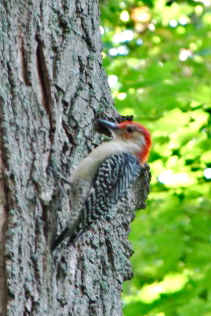
| Red-Bellied Woodpecker, Faver-Dykes S.P.,FL |
the clown-
faced woodpecker probing the dead sculpted trunk
of
that black birch
holding
her
small shoulders in my hands sometimes,
I
felt a violent wonder at her presence
like
a thirst for salt, for my childhood river
with
its island willows, silly music from the pleasure boat,
muddy
places where we caught the little orange-silver fish
called pumpkinseed.
the
way her hands dismantled bread,
the
thing her father said that hurt her,
In these quotations, I hope the differences between
abstract, aphoristic expression and concrete imagery are clear as two different
modes of being and awareness.
Moreover, at the center of the poem, Hass offers two lines
that encapsulate the two kinds of mental operation.
talking
this way, everything dissolves: justice,
pine,
hair, woman, you and I.
 |
| Pike's Pond, Lenox, MA |
The first line is general, summarizing, abstract
declaration, ending in one of the greatest abstractions of all, “justice.” But
immediately the following line plunges completely into the physical, concrete,
immediate world, so that a dualism is clear.
Of course, the most emphatic image of sensuousness, and the
victor if there’s been a contest, is the single, italicized, repeated word and
physical image, blackberry. Can the “good flesh” continue?
Hass is too wise to choose between black hats and white
hats, but he would like a world and a life in which “numinous” flesh could go
on and on, physical and mortal on the one hand, spiritual, mental, and endless
on the other. And he imagines a third “numinous” hand, which contains both ways
of being—the temporal and the eternal—and thus requires no choice by the human.
To try to articulate that world, all he can do, ironically, is repeat a single
word, the odd, beautiful center of sensuality: blackberry.
I don’t mean to force some happy (or haughty) ending about Thanksgiving when I
say Hass might be giving us something good to be thankful about—something more
elevated and meaningful than gorging on turkey or lining up at 1:00 a.m. to
gather more stuff.
Meditation at Lagunitas by Robert Hass : The Poetry Foundation
Meditation at Lagunitas by Robert Hass : The Poetry Foundation




 Posts
Posts


