Apr 25, 2013

Rainer Maria Rilke, "Archaic Torso of Apollo," trans. Stephen Mitchell

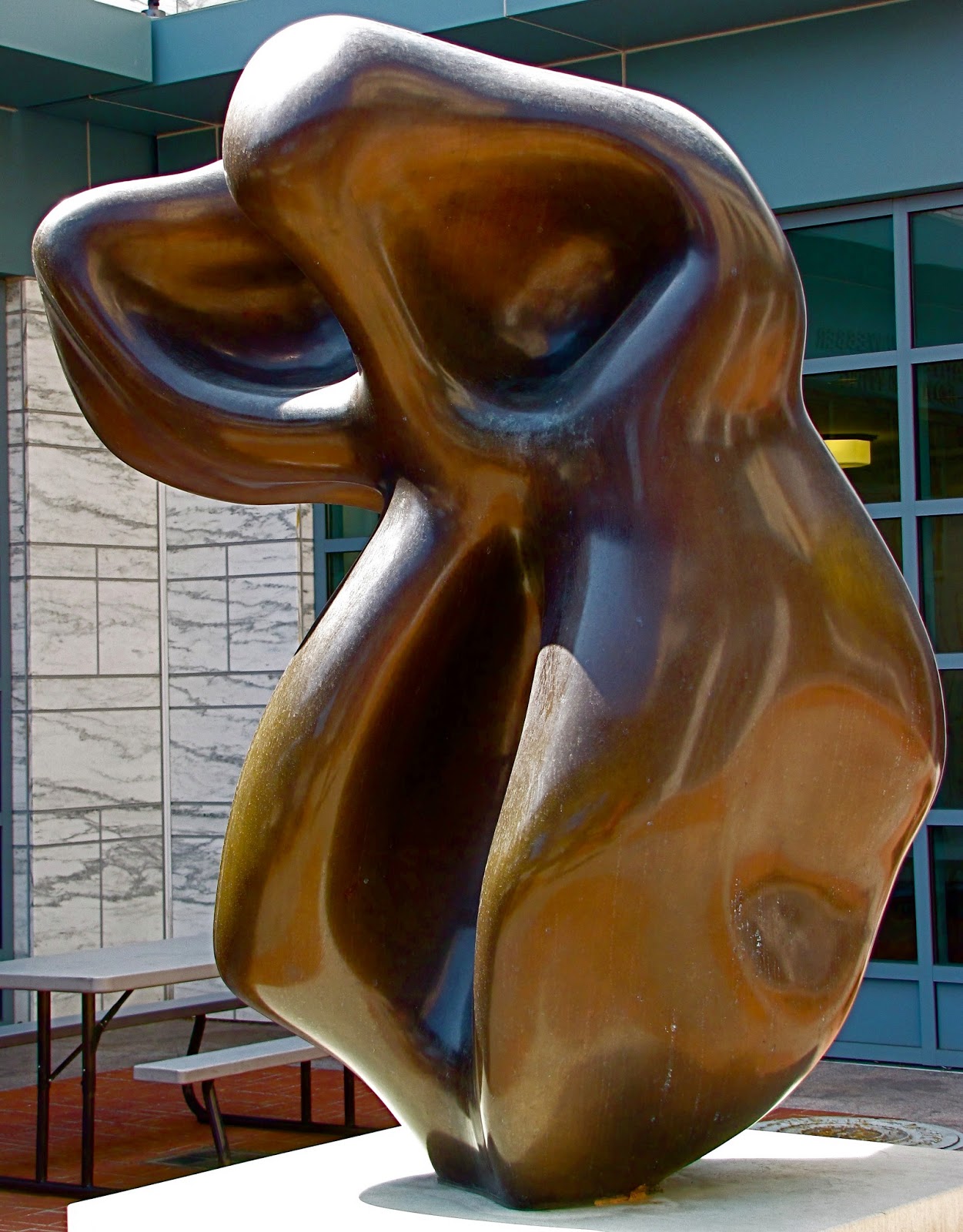
Arp, Torso of a Giant, 1964, D.I.A.
I hadn’t read Rilke’s “Archaic Torso of Apollo” in a long while, and frankly I’d forgotten about it. That's shameful, but instead of leading vapid, jejune cheers about the poem and its perplexing conclusion, let me simply admire a few of its particulars.


First, let’s note that it’s an Italian (or Petrarchan) sonnet, fourteen lines that begin with a rhymed octave (8 lines) to which a 6-line, rhymed sestet responds in some way. So it’s a bit similar to an English (or Shakespearean) sonnet’s concluding with a rhymed couplet that responds to its preceding twelve lines.

How translators manage to preserve any kind of rhyme has always impressed me. I’ve read somewhere that a good translator often has to make the choice of what’s primary—the poem’s content, including literal translation, or its formal characteristics such as rhyme and meter. At any rate, that kind of intelligence is magic to me, so hats off to Stephen Mitchell.


Apollo was the god of truth and light as well as music, poetry, and some other good things, and as foil to that loosey-goosey, hell-raising frat boy, Dionysus. I think of Apollo as the god of reason and moderation.  So the figure of a decapitated Apollo might suggest an entirely physical, animal power (“like a wild beast’s fur”) with too little wisdom or soul to “burst like a star” “from all the borders of itself.” The thinking god has lost his head.

The danger of a god’s sexual power might feel menacing us, especially as we remember Zeus' rape of Leda, the mortal, who gave birth to the child who would become Helen of Troy, and be partially responsible for a ten-year war, as her Greeks tried to retrieve here. But in Rilke's Apollo, we perceive “a smile” running “through the placid hips and thighs /  to that dark center where procreation flared.” Even there, at the “dark” sexual center, which might be anarchic power in an animal or human, the god’s internal “brilliance . . . like a lamp” illuminates and “dazzles”; he's  empowered with the light to see everything we do, even without his head.

Here, I'm reminded of Yeats’ “Leda and the Swan,” another knockout sonnet, which concludes by wondering if mortal Leda takes on the rapacious Zeus’ “knowledge” with his power before “the indifferent beak could let her drop.” And there’s James Wright’s memorable, disturbing conclusion to “Lying in a Hammock”—“I have wasted my life.”  I wonder if Yeats and Rilke, as contemporaries, were consciously or unconsciously influenced by each other. And did the younger James Wright owe a debt to Rilke's  sonnet?

Here’s a little game to play:  put Rilke’s first and last lines together, and we get “We cannot know his legendary head. . . . You must change your life.”  Apollo’s “legendary head” is missing from the sculpture, so in both literal and figurative ways, we cannot know his inner life. 
More importantly, we cannot know it because we are mere mortal schmucks. Light does not explode from our torsos and make our dark crotches glow with smiling benevolence. Maybe most of us would rather come across as Darth Vader anyway. 

But how shall we change our lives—to be more like the god or to be more submissive to him? Shall we try harder to emulate Apollo’s light, though we know it’s a doomed effort? (Maybe Sisyphus thought so as he rolled his rock up the hill). 
Or, since we cannot be immortal or comprehend divinity, should we become more modest and submissive, accepting the limits of our puny knowledge and the sinister darkness of any power we have?

Are there third and fourth and twentieth ways to read Rilke’s last line?

My thanks to poet and professor Carol Muske-Dukes for returning me to Rilke’s sonnet, which she discusses from a different perspective in her essay, “What Is a Poem?” (in The Eye of the Poet: Six Views on Craft, ed. David Citino). 

We should remember that the purpose of literary criticism and scholarship is leading well-intentioned readers from one worthy poem, poet and idea to another. Too often the whole enterprise is debunked as academic charlatanism, the smelly alley to tenure, promotion, and ego-enlargement within The Academy. 

To be sure, some of it is that, but much of it consists of one well-lit head shining a light for others who want to know . . . and accept the fact that they need to know. 


Apr 17, 2013

Alicia Ostriker, "April" and "In Every Life"

Do you have a preference between these two spring poems by Alicia Ostriker?  Whatever your answer, isn't it good to find serious, intelligent, probing poetry that's also playful?  

April by Alicia Ostriker : Poetry Magazine

In Every Life by Alicia Ostriker : Poetry Magazine


Apr 10, 2013

Anonymous

Visitors, I fear these Anonymous jerks might force me to go back to that reader screening gizmo we all hate. Any suggestions?

Apr 8, 2013

Roethke's "The Waking": Kinds of Travel


Still on the subject of travel, broadly and metaphorically defined, here is Theodore Roethke’s masterful villanelle, “The Waking,” which I’ve posted before, but not since I was a kid, three years ago. I paired it then with Edward Hirsch's "For the Sleepwalkers," which still makes a logical, nice, dreamy connection in my mind:


And here’s what readers and I said about the poem in April 2010:


I’ve always heard “The Waking” as a hymn or prayer, an anthem I usually fail to live up to, though I keep trying. If we cannot talk about—or even take time to think about—how “light takes the tree,” or to listen to our being “dance from ear to ear” (in our best moments), why are we arranging for gawking tours on perfume-y buses? Or cruises that fail?

Say, do those buses have restrooms these days?


Mar 28, 2013

FROST'S "MEETING AND PASSING": When It's Travel and When It's Only a Shuffling of Feet


Most Americans these days measure travel by the hundreds or thousands of miles, plus introductions to other cultures, languages, features of landscape and human morphology. On its face, that’s all fine, of course; one’s understandings and tolerances might grow because of such exposure.

Or they might not. Stories of rigid, dug-in, self-righteous American tourists are too familiar. The tour buses might as well be labeled Upper Middle Class American Caucasians, peering and aging.  Younger people with backpacks, staying in hostels or actually living in an-Other Place, on some kind of study or exchange program, might become spongier vessels, at least for a few years. 

I’m not ready to say tourists should stay home, but I’m also not jumping to the conclusion that they’ve achieved anything like charitable omniscience and empathy, especially those on the bus. I’m more interested in travel of the mind and heart, which can probably occur in a single chair. That’s an old notion (I think of Emily Dickinson’s “There is no frigate like a book”), but I don’t hear much talk about it.
So here is a Robert Frost sonnet I didn’t know until the Academy of American Poets     www.poets.org posted it as their poem for the day.  Like much of Frost, it feels so casual and general that we might overlook its potential to become The Poem about the nature of human encounters.  

As I went down the hill along the wall
There was a gate I had leaned at for the view
And had just turned from when I first saw you
As you came up the hill. We met. But all
We did that day was mingle great and small
Footprints in summer dust as if we drew
The figure of our being less than two
But more than one as yet. Your parasol
Pointed the decimal off with one deep thrust.
And all the time we talked you seemed to see
Something down there to smile at in the dust.
(Oh, it was without prejudice to me!)
Afterward I went past what you had passed
Before we met, and you what I had passed.


In the final couplet’s word play, I sense a purposeful incompleteness, ambiguity, open-endedness, something dangling. These two characters have talked in a seemingly friendly way. Their footprints have mingled in the dust as they cover more or less the same territory.

A lesser mind than Frost’s might have blissfully concluded that there’s been meaningful communication between the two characters, but I think he’s offering that what they’ve missed in terms of knowing each other is at least as significant as what they’ve shared. They’ve met, passed, shared paths, mingled “great and small”—but Frost’s sneaky enjambment demands that we keep going, to discover that what “mingled great and small” was their footprints, not their souls or hearts.  And the outline of those footprints is etched in dust, not moonlight and roses.

If we meet, we talk, we pass, and then sort of cover each other’s steps, like trackers, how much meaningful bonding has occurred? How much can occur?  I think Frost’s position here parallels his wonderful ambiguity in his more famous line, “Good fences make good neighbors.”  (“Mending Wall” http://www.poetryfoundation.org/poem/173530).  That need for boundaries is ambiguous because he puts it in the mouth of a less than wonderful character, the speaker’s neighbor. But isn’t there truth in his words? But isn’t it a sad truth?


Mar 15, 2013

Bluegrass: a Primer


Titling this blog Banjo52 might imply more knowledge of bluegrass and other roots  music than I actually have. On the other hand, I love a lot of it, and Karin at altadenahiker.blogspot.com has just reminded me that there might be folks out there who could use an injection of mountain music but don’t know where to begin. So here’s my ounce of contribution toward a beginning dose of bluegrass. 

My list and links are tilted toward artists who are not so nasal or shrill that they’d put off the new or casual listener. If you google a few of these folks, you’ll also see and hear that bluegrass is a specific kind of country music. While there’s some overlap with Nashville, as well as blues and folk music (especially Scots-Irish), bluegrass is its own critter.

The traditional band includes acoustic guitar, banjo, bass, fiddle, and often mandolin and dobro.  Drums? Piano? Brass?  Never, as far as I know, but “Fusion” is one of the F-words of contemporary culture . . . .  Fusion is also the reason I haven't included Steve Martin or Bela Fleck; they are supremely talented banjoists, but their musical adventurism usually takes them beyond bluegrass, at least in my loosely defined terms. 

Ralph Stanley and Bill Monroe go back to the 1940s or earlier, so they have some of that shrillness, but it’s still good stuff.

Lester Flatt and Earl Scruggs began to make inroads into the folk music of the 1960s, and Alison Krause and Emmylou Harris have completed that trend.  Also try the inimitable Doc Watson. I can’t imagine his offending anyone, and newcomers might embrace his mellow voice and soft brilliance on guitar.  If someone objects to his lullaby (next to last in the following lists), keep it to yourself. 

The first three below are older artists, followed by a few notable younger performers (though only Chris Thile is anything like a kid—well, Gillian Welch might not have any gray hair yet). 

Mother Maybelle Carter  (or, the Carter Family)
June Carter Cash    (Maybelle’s daughter, Johnny Cash’s wife)
Jim and Jesse
Tony Rice
Gillian Welch
Iris DeMenthe
Chris Thile  
Black Diamond (West Virginia)
Tom Adams
Norman Blake
Leo Kottke

Too Much of a Good Thing? 

Also, you could google any of the names John Hartford mentions in this link in addition to hearing a somewhat homogenized version of a classic:


Earl Scruggs, Doc Watson, Ricky Skaggs:


Doc Watson and Chris Thile

June Carter Cash 

Doc Watson, a lullaby     https://www.youtube.com/watch?v=kYSIFzSX7E0

Sleepy Man Banjo Boys (even kids do it): 


I hope this info, fundamental as it is, starts a stampede.  If you do some wandering on YouTube, please permit yourself some extra pleasure by looking entering “clog dancing” in the search bar. 

Mar 4, 2013

Anne Sexton's "Letter Written on a Ferry While Crossing Long Island Sound"

-->

As the photos suggest, I’m sometimes infatuated with the ocean, though all I do is look at it. But who can deny that the sea’s motor goes on and on and on. Surely it will wear out someday, yet it doesn’t. Only the sky is bigger. So we sometimes become annoyed at the hugeness and endlessness of oceans, which so belittle our human situation. At the same time, who can fail to be stunned mute at all that action, all that beauty?

Anne Sexton, for one.  I think the opening of her "Letter Written on a Ferry . . . " is an absolute winner and attention-grabber, even as it considers attributing to the 


ocean the speaker’s ennui:

           I am surprised to see
      that the ocean is still going on.

Today, rather than going on and on about the jackpots I’ve found in a poem, I'm asking readers to pick their favorite images or lines from the poem. Although I love several of Sexton’s details, today I'm just as fascinated by the progress of her observations and thoughts. How does she get to the nuns and what is it that she’s doing with them, particularly after the opening references to her failing relationship, to life preservers, life boats (made of cement!), and seemingly crucial little items for getting us through our lives. Can keys and wallets save her, or us? 

I was waiting for Sexton to turn on the nuns and criticize or mock them. However, while I hear some comedy in certain details, I think the overall picture is respectful. She sees the nuns as having found a way to escape the oldness of the sea; unlike the speaker, they are not weighed down by lost love and aging. In fact, doesn't Sexton envy them, perhaps because they're safe up there, out there, flying above the perils of romantic relationships, with all that gravity and the pull of the sea?  


Lovers' Lane