Showing posts with label cummings. Show all posts

May 8, 2014

Poking and Prodding: e.e. cummings’ “O sweet spontaneous” and the Nature of Nature (and; un-Schooling


At Kensington Metropark the other day, I discovered an island hubbub, a rookery full of Great Egrets, Great Blue Herons, and Cormorants. Below them Canada Geese squawked. Closer to shore, red winged blackbirds clung to reeds and half-seriously threatened me, I assume because of nearby nests. Two male geese squared off as if to fight—much hissing and honking in goose profanity, I'm sure. Later, two male redwings got into the longest physical squabble (maybe ten seconds) I’ve ever seen between two birds. At home, the wiser gold finches, doves, cardinals, and sparrows make only symbolic gestures of combat. 
 
My big birding day at Kensington got me thinking even more about spring and nature, and that reminded me of e.e. cummings’ poem,  “O sweet spontaneous,” in which he offers mockery and contempt for philosophy, science, and religion. Whatever those three endeavors might be, what they are not—and never will be—is spontaneous. They are considered, rehearsed, systematic invasions and perversions of nature, which is so magical and supra-rational that spring, season of rebirth and renewal, is the “rhythmic/lover” of death.


Nature is spontaneous in the sense that it simply is; it cannot be understood empirically. Philosophers and scientists are “prurient” and “naughty” voyeurs, while religionists try to knock nature around, “buffeting” it as they attempt to pull gods from its womb. Is that not a rather violent image of birthing, perhaps suggestive of abortion?

In the ongoing American hostility and debate about evolutionism vs. creationism, what might e.e. cummings say? And what might he say about religion in the schools? Would he tell us to avoid teaching philosophy, science and religion altogether?

As a poem, “O sweet spontaneous” is surely vulnerable to charges of oversimplification and sentimentality (that is, excessive or unearned emotional content).  Does it cross that line into touchy-feely, art-fart mush? Or does it try to demonstrate through simplicity its own argument that nature and the cosmos cannot be known in Academy-sanctioned curricula? 
Does the poem ask us to plop the kid in a field to witness the elk and experience snakebite? Shall we cancel science classes nationwide? What would a school run by cummings look like?

What would cummings do about climate change? Or cancer?

Would he argue that pantheism, animism, atheism and their ilk are also “prurient,” “naughty,” and “squeezing” and “buffeting”?  Do they too have “scraggy knees”? Or is it only mainstream schools of thought that are villains and morons? Kill the Presbyterian, let the hippie roam.
 
See how easy it is to take cummings to task? And aren’t his anti-traditional punctuation, capitalization, and diction rather juvenile, facile, disingenuous rebellions?

Or are they the most honest, urgent, cogent way to challenge authority? Maybe they demand that we experience the world as cummings does, unfettered by semicolons.
 
Whatever the case, when I’m having a good experience in nature, what I’m feeling feels unknowable—fwom de pwitty wittle finchee (change now to a baritone voice) to the big mean hawk that eats him (“the incomparable/couch of death”?).  What I’m experiencing might be such a vigorous firing of neurons, or such a jiggling of stardust as it wiggles with what I am, that no mere empirical Discipline can touch it.

Surely the solution is to invite politicians to write up an exam that tests a student’s life-essential knowledge at age 15. For if politicians don’t know what must be learned, who does? 


Oct 10, 2013

e.e. cummings, Robert Frost's "Design" and Politics 2013

Design by Robert Frost        

Robert Frost’s Italian sonnet, “Design” is somewhat similar to e.e. cummings' English sonnet, “When Serpents Bargain”   (when serpents bargain for the right to squirm... (22) - Poem By E. E. Cummings - Read Classic Poetry Online) in asking questions about the nature of animals, humans, and the possibility of order in the universe. “Design” tends toward philosophy while “When Serpents Bargain” is a satire on the legal and commercial dealings of humans.

Strangulation in High Places
But both poems convey dark themes softened by lightness, innocence, playfulness in language and tone—more so in “When Serpents Bargain” than the grimmer study of animal behavior and the possibility of cosmic chaos in “Design.”


In my October 2 post on cummings’ “When Serpents Bargain,” I mentioned that I’d been a little cantankerous about the poem back on April 7, 2011.  (No pressure, but it’s here if you’re interested: 

(http://banjo52.blogspot.com/search?q=when+serpents+bargain).

Although I share cummings’ dim view of human wheeling and dealing, in which every serpent-of-a-person is trying to sell a used car in bad repair, it might be childishly romantic (reverse narcissism?) to think we’re crazier than critters in nature. 
Congress
We might be trying and failing to deal with complex matters of morality and law (witness our present situation in the U.S. Congress), 
but animals solve their diplomatic problems by eating each other. 
Gunboat Diplomacy

Also, when an animal fails, he dies alone in the field for lack of medical care or food. Birds fall out of the sky. The philosophizing, lawyer-izing verbiage that cummings mocks in “When Serpents Bargain” is our spastic effort to avoid eating each other or dying alone in a field. 

Maybe the animals’ free-market way is good for Republicans, Libertarians and anarchists, but me, I’ll take the modified welfare state, yes, the Nanny state. What’s wrong with nannies? They’re paid to like us when our parents are too busy or too mean for liking. They're paid to be kind. When we get a haircut, we don’t bellow about The Barber State, do we?

I prefer the limited version of Nanny State that encourages earning our victuals and our pleasure, but let’s not go all Tea Party and dump people on the curb to bleed out if they fail or get sick. Alone. Except for the Tea Partier, who is the stranger standing over the fallen man and chanting Bible verses or Christian rock music. The guy on the curb needs macaroni, not a parable. 


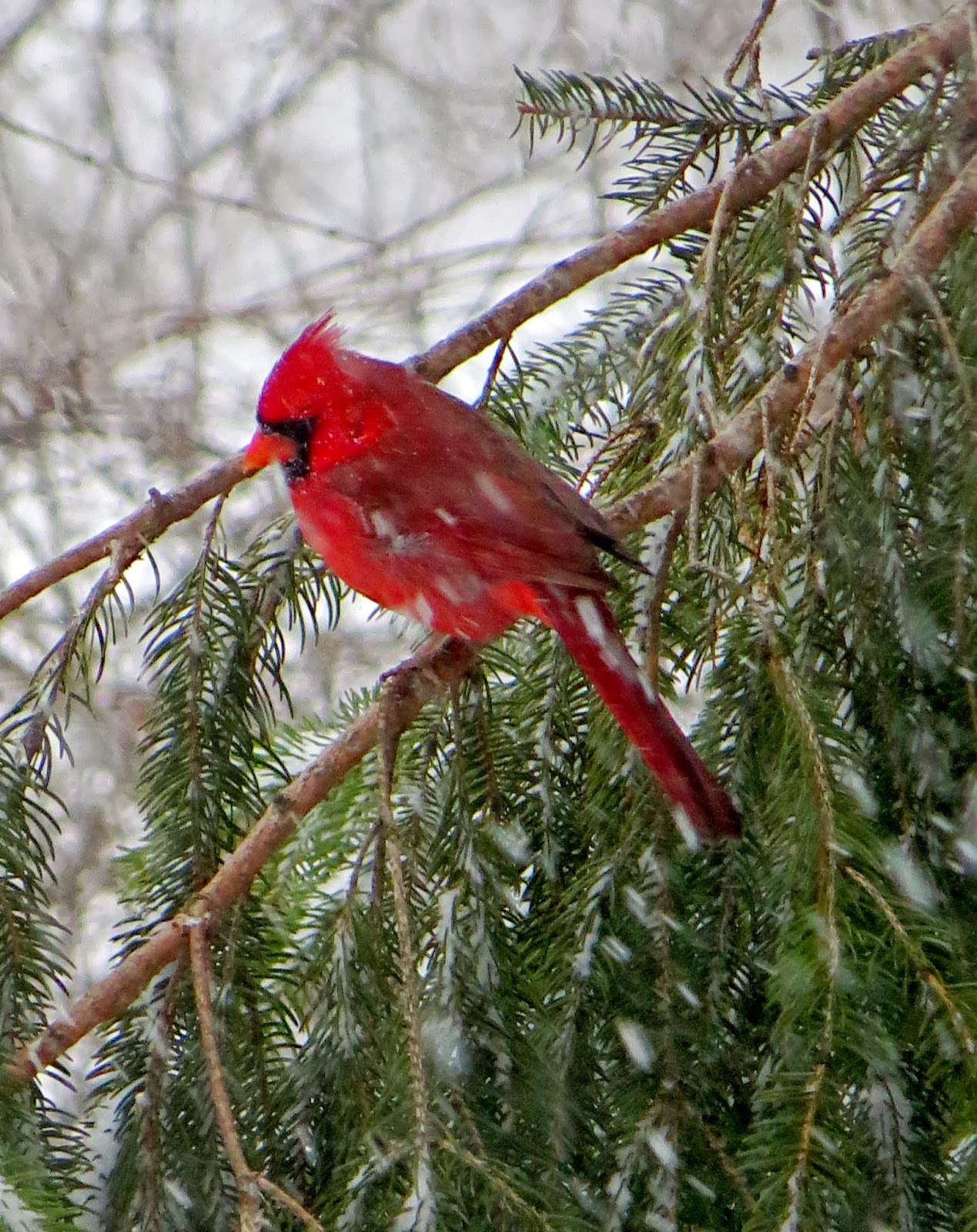
Maybe the heroic cardinals have it right. A couple of years ago I mentioned here my cardinal couple, who, for about a week, adopted and fed, beak to beak, an orphaned white-crowned sparrow chick, in my back yard.
Steadfast but Pondering

Tom, my most hard-core evolutionist friend, thinks I’m lying about that. He said, “But John, I don’t see the evolutionary advantage in [the cardinals’] behavior.” As gently as possible, I said, “That’s the point, Dumbass!”

I restrained myself from going all Hamlet-and-Horatio on him, but I was on the verge of reminding Tom that “there are more things in heaven and earth, Tom, than are dreamt of in your philosophy.” (Everyone should have a friend named Horatio. Look what he did for Miami forensic investigations). 

By the way, my friends and I regularly refer to each other as Dumbasses or worse. That’s one thing I like about us. We tell the Truth on those rare occasions when we can find it. On the other hand, each of us thinks he’s found Truth way more often than he has. I suppose that makes us pretty Tea Party-ish. Once again, irony thrives, even in a world full of blinders and misguided faux earnestness.
Self-Strangulation


The fact remains, I witnessed those cardinals for several days as they fed the Other, the alien, who might grow up to compete with them for food. I called the local Audubon Society, which confirmed that such charity happens in the animal kingdom, and yes, cardinals are among the chief do-gooders. Nanny Cardinals. Baby sparrows.

*

Oct 1, 2013

e.e. cummings, "when serpents bargain." A Little Drummer Girl.


Some politicians are at it again. I'm baffled.

The video below is a partial antidote for me, even better than poetry. Maybe it will be for some of you too. If you're short on time, be sure to skip ahead to the two-minute mark to hear the kid take off in a kind of pleasure (rapture?) that's rare. Watch her face. Even her old man on piano has an oddly winning way about him.

I was going to say you should not play this at a funeral or a library, but it might be just the thing:

http://www.youtube.com/watch?v=KnnbYagLaXM


If, in the privacy of your rooms,  that father and daughter are no help, I wonder if something big is wrong at your place. 

Or maybe I'm just your poetry-shoeshine boy, in which case here's an e.e. cummings that might be relevant.

e. e. cummings
"when serpents bargain for the right to squirm"
 

when serpents bargain for the right to squirm
and the sun strikes to gain a living wage--
when thorns regard their roses with alarm
and rainbows are insured against old age

when every thrush may sing no new moon in
if all screech-owls have not okayed his voice
--and any wave signs on the dotted line
or else an ocean is compelled to close

when the oak begs permission of the birch
to make an acorn-valleys accuse their
mountains of having altitude-and march
denounces april as a saboteur

then we'll believe in that incredible
unanimal mankind(and not until)

1944


If you'd like some commentary, I wrote about the poem in April of 2011. My post is a little cantakerous, but its point of view is worth keeping in mind as we tend to romanticize about the romanticizing e.e.  He has a way with words and feelings, but his thinking can be a little . . .  loosey-goosey?

http://www.blogger.com/blogger.g?blogID=2883979841111173610#editor/target=post;postID=4864430106143452219


May 5, 2011

e.e. cummings, "O sweet spontaneous"

In the backyard, this young squirrel would seem ho-hum daily fare. But in the woods, I felt as if I'd discovered the essence of squirreldom  (Independence Oaks, near Clarkston, Michigan).


Ditto the Tree Swallow pair; a purist might be put off by their being coaxed, trained, hoodwinked by that box. Not me. Except for cages, a nice bird is a nice bird.

"O sweet spontaneous" is one of the cummings poems I fell for in college, and I still like it. It's the best of both worlds; I don't have to admit to being a completely mindless sap in youth or a jaded, dessicated academic in the 21st century, too learned for such hormonal advocacy of the irrational. 

O sweet spontaneous - A poem by e.e. cummings - American Poems

Nov 1, 2010

Election Eve with W.B. Yeats and e.e. cummings


The two poems below acknowledge Election Day tomorrow. I was going to post words of my own, but they turned out rather grumpy about people from the other village (need a reminder about village people? see Oct. 27). The other village that wants to put paranoid hate-mongers in the C-place and substitute soundbites for reasons and phantom thrift for generosity, compassion, the public weal.

So I’ll let Yeats and cummings do the talkin’, although the Yeats is quite grave and cummings, the old hippie, sounds oddly Republican, with his anti-regulation theme. (e.e., Old Buddy, My Man, serpents and other critters also eat each other).

Competition can be healthy. Sensible games can be played hard by sensible people, under sensible rules. But without guidelines and their own purity of intent, athletes at sunset can end up feeling stranded on alien notions of a field of play. They feel bad; they've learned nothing good.

The Second Coming by William Butler Yeats : The Poetry Foundation [poem] : Find Poems and Poets. Discover Poetry.

when serpents bargain for the right to squirm... (22) - A poem by e.e. cummings - American Poems

Jul 14, 2010

Cummings, Dickinson, Purple Finches


I think I read it right: the eyes of small birds do not rotate in the skull the way ours do; that's why they're always tilting, jerking, twitching their entire heads to catch an image.

I think this posing guy, with no dark patch on his crown, has a rich enough raspberry color to be labeled purple finch and not "just another" house finch. I have to catch myself on the verge of thinking "just another" cardinal, "just another" gold finch. They bring pleasure every day, but are not as exotic as, say, a Northern Parula Warbler at Magee Marsh.

The purple finch also made me think of e.e. cummings. Again. If the children in the poem were yours, would you be OK watching them follow the balloon man out of sight?

[in Just-] by E. E. Cummings : The Poetry Foundation [poem] : Find Poems and Poets. Discover Poetry.


But in case that's too easy--or God forbid, too happy--here's Emily again, thinking of a lover. Did we know she thought of lovers? How could we not have suspected?

Wild nights - Wild nights! (269) by Emily Dickinson : The Poetry Foundation [poem] : Find Poems and Poets. Discover Poetry.

**

May 17, 2010

e.e. cummings, "anyone lived in a pretty how town"


anyone lived in a pretty how town - Poets.org - Poetry, Poems, Bios & More

"anyone lived in a pretty how town" has always been one of my favorite cummings poems. It might see the best there is in human love, and it captures small town life about as well as any writing I know, even though it consists of fancy and allegory more than detailed realism.

In Republic, Ohio in the year 2010, there sits Anyone in the hot red car he borrowed from a buddy to impress Noone. He's meeting her for lunch downtown at Fathead's restaurant. Republic has seen better days, but it's still a pretty how town.

Of course, that's only the beginning. Harvey and Lolo are also Anyone and Noone at the other end of the story. Why not? And why not make Anyone a veteran?

Lolo was ten years younger than Harvey, though each ended up with 88 earth years. Not too bad.

I wonder what they talked about. Maybe they had supper in front of the TV after about 1960, though the picture was probably pretty snowy until the cable came in around 1980. Did they watch Walter Cronkite or Huntley-Brinkley? Most likely they got only one channel and didn't have to choose.

anyone lived in a pretty how town - Poets.org - Poetry, Poems, Bios & More


* *


Lovers' Lane